2026 SMB Cybersecurity: Surviving the AI Trust Crisis
A strategic roadmap for navigating deepfakes, agentic AI risks, and the $1.5M ransomware reality.
The business environment for small and mid-sized businesses in 2026 has transitioned from a period of digital transformation into an era of digital friction, where the speed of technological adoption frequently outpaces the development of governance and security frameworks. For tech, cyber, privacy, and legal leaders, the current landscape is defined not by the novelty of individual threats but by their unprecedented scale, personalization, and automation, all driven by the democratization of advanced artificial intelligence. The following report serves as a strategic briefing for the weekly newsletter, synthesizing critical research into actionable business intelligence for the modern enterprise leader.
The Strategic Threat Landscape and Foundations of Resilience
The Weaponization of Machine Speed and the Crisis of Trust
In 2026, small and mid-sized businesses will have officially surpassed large enterprises as the primary targets for organized cybercriminal groups. This shift is not a matter of prestige but of cold mathematical efficiency. While a large enterprise may offer a higher individual payout, the explosion of attacker-friendly AI tools allows criminal syndicates to target hundreds of SMBs simultaneously with the same level of sophistication that once required a bespoke nation-state campaign. Attackers no longer strike more often; they strike smarter, utilizing automated bots that generate more than 36,000 vulnerability scans per second, a volume that accounts for more than half of all internet traffic.
The psychological core of this new threat landscape is what experts describe as a “crisis of trust”. The foundational assumption that a leader can verify an identity through a phone voice or a video call face has evaporated as generative AI enables deepfakes and voice cloning that are cheaper to produce than to detect. This erosion of trust is not merely a security concern; it is an operational bottleneck. Employees who doubt the authenticity of internal requests may hesitate, escalate unnecessarily, or follow incorrect processes, slowing down the very business speed that AI was supposed to accelerate. Business Email Compromise (BEC) has matured into Business Process Compromise, where AI-powered loops simulate entire verification workflows to authorize fraudulent financial transactions.
The Economics of Exposure: The Insolvency Gap
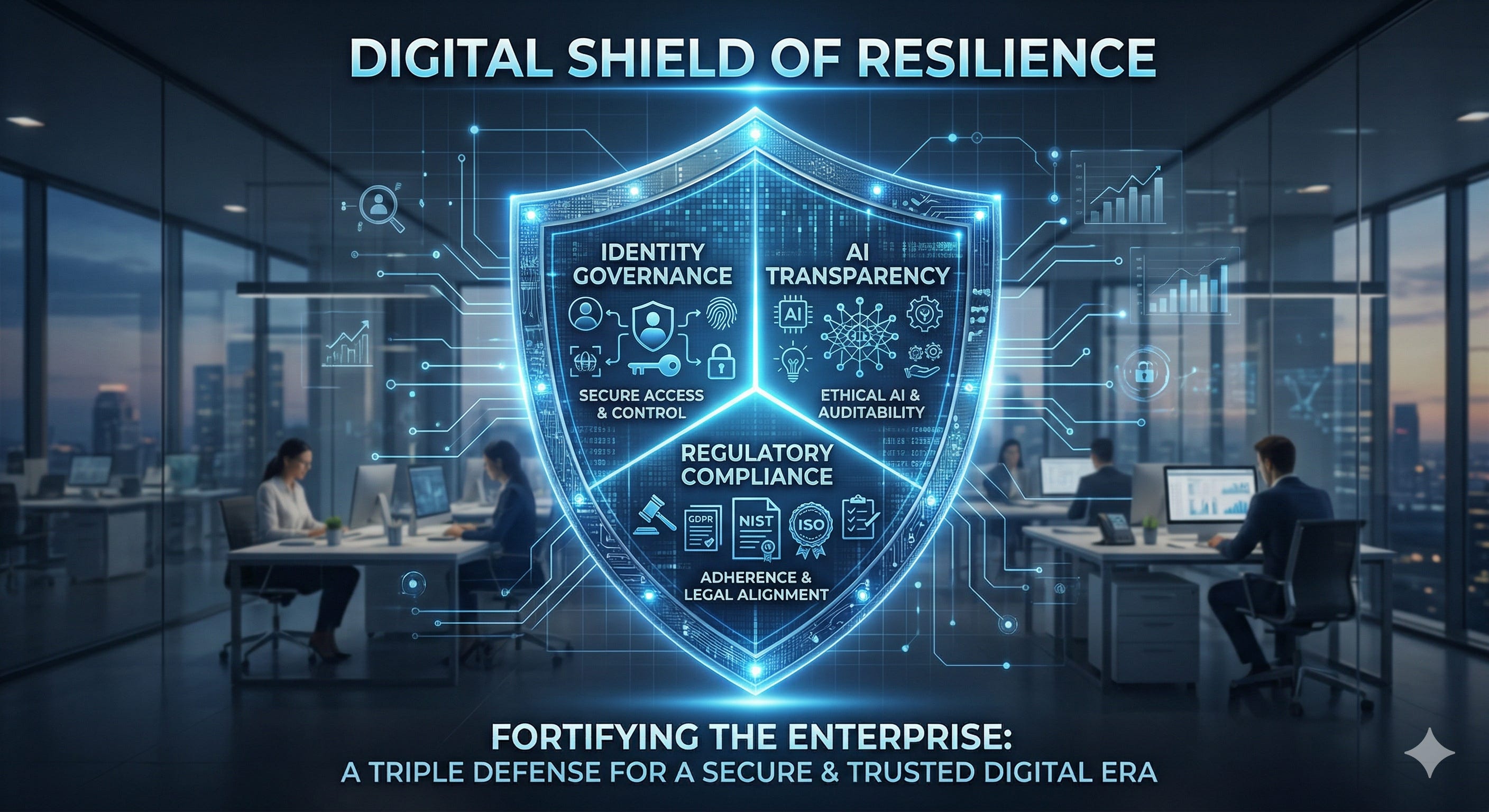
The financial implications of a cyber incident in 2026 have reached a critical state for the SMB market. Research identifies a widening “insolvency gap,” where the median U.S. SMB holds approximately $12,100 in cash reserves while facing an average cyber insurance claim of $264,000. This 22-to-1 ratio highlights the existential nature of even a single breach. Furthermore, approximately 40% of cyber insurance claims are now denied, with 82% of those denials stemming from an organization’s inability to verify compliance with Multi-Factor Authentication (MFA) protocols.
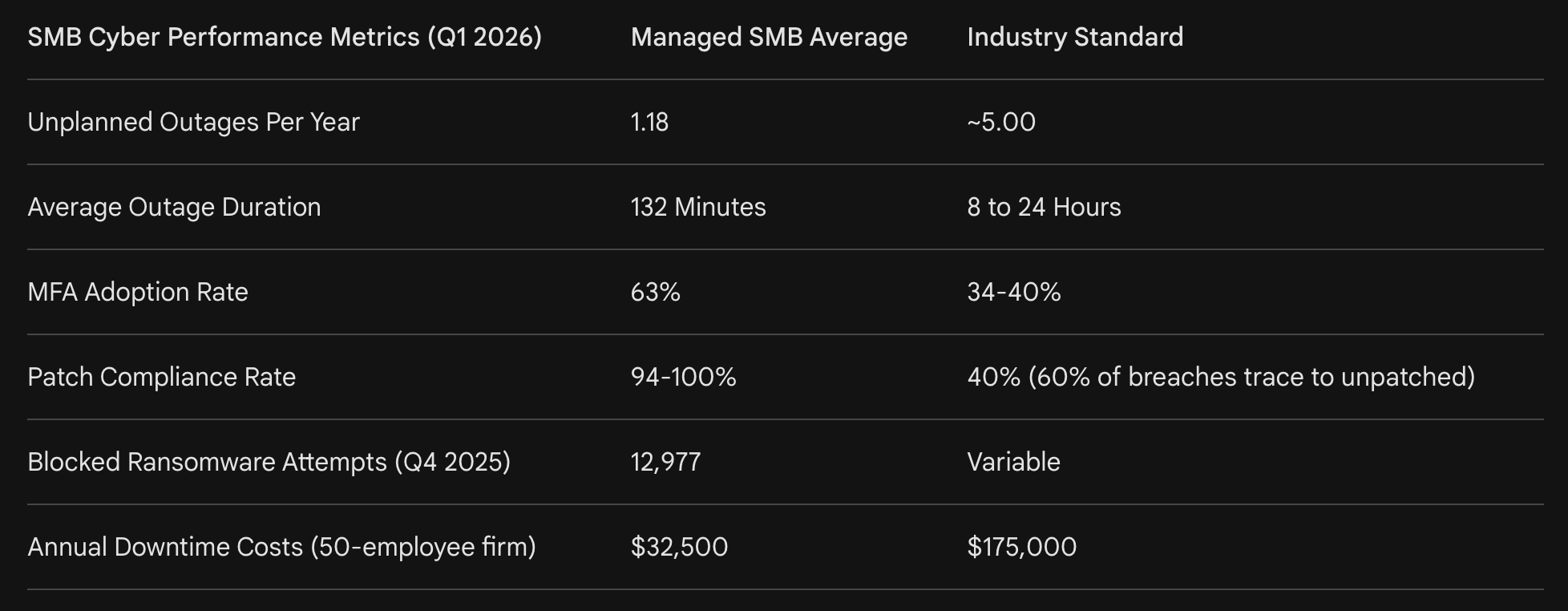
The data suggests that the cost of proactive security is significantly lower than the cost of failure. Managed clients in 2026 saw four times fewer outages and downtime costs that are 80% lower than industry averages. However, a critical recovery gap remains: only 5% of SMBs have documented Recovery Point Objective (RPO) and Recovery Time Objective (RTO) targets that have been tested within the last 90 days. This suggests that while perimeter defenses are maturing, the ability to survive a successful breach—business resilience—remains a secondary priority for many leaders.
Strategic Mitigation: Transitioning from Tools to Governance
The persistent challenge for SMBs in 2026 is “over-tooling and under-protection”. Organizations have continued to invest in security products, yet they struggle with fragmented visibility and inconsistent protection because they lack the governance to support those tools. Without clear asset inventories, defined responsibilities, and standardized practices, alerts go unaddressed and expensive technologies fail to deliver their intended value.
The shift from a reactive, checklist-driven security posture to a risk-directed approach is essential. This requires organizations to view security not as a technical hurdle, but as a core business process. In this environment, the most valuable asset an SMB can acquire is strategic expertise. Organizations that lack the internal resources to navigate these complexities often seek guidance from a dedicated security partner.
Omnistruct provides the strategic expertise needed to build and scale privacy, GRC, and security programs, empowering teams to achieve business goals without sacrificing compliance. By serving as an embedded security partner (BISO), Omnistruct delivers executive-level guidance and hands-on support to mature an organization’s security posture and align it with core business objectives.
Immediate Actions for Improvement: A 90-Day Action Plan
To close the gap between exposure and protection, leadership should focus on three primary pillars of resilience in the coming quarter: identity hygiene, process verification, and recovery readiness.
Identity Hardening: Organizations must transition critical users—including admins, finance, and executives—to phishing-resistant MFA, such as hardware tokens or passkeys. Push approvals without number matching should be disabled to prevent fatigue-based overrides.
Out-of-Band Verification: To mitigate the risk of deepfakes and AI-generated impersonation, leaders must implement mandatory waiting periods for first-time payments to new accounts and require verbal confirmation using pre-shared phrases or “trust codes” for urgent financial requests.
The 90-Day Restore Test: Beyond simply checking backup logs, organizations must perform a test restore of a critical file and time the process to validate their RTO and RPO targets. Verification of off-site backup functioning and cloud storage capacity is essential for surviving a ransomware event.
You’ve seen the "Why" behind this [Cyber/Tech Issue]—but knowing the risk is only half the battle. To move from awareness to actual protection, you need a localized execution plan.
The remainder of this deep dive is designed specifically for the SMB leader who needs to move fast without a massive enterprise budget. By upgrading to a paid subscription, you unlock:
The “How-To” Framework: A step-by-step breakdown of the [Process/Tool] mentioned above.
Resource Toolkit: Downloadable templates and checklists I use with my private coaching clients.
The Bottom Line: Direct analysis of the ROI and cost-savings associated with this strategy
Help Other Leaders Secure Their Future
The Network Effect of SMB Security
The most effective way to strengthen our SMB community is by sharing the strategies that actually work in the field. If you find value in these technical deep dives, helping a fellow leader bridge their tech gap makes the entire ecosystem more resilient. Cybersecurity is a collective effort, and more informed peers lead to a safer environment for everyone’s business.
Why Share This Subscription? When you refer a colleague to this newsletter, you are giving them access to the same specialized insights you use to lead your team:
Zero-fluff technical execution: No high-level theory, just the steps to implement.
Cost-saving vendor analysis: Honest looks at which tools are worth the SMB budget.
Direct coaching frameworks: Access to the same logic I use with private coaching clients.
Pay It Forward Use the button below to share this post or your unique referral link. When your peers join our community, we all benefit from a more secure and tech-forward marketplace.
Subscribe to Unlock the Full Strategy
Join a community of SMB leaders who stop reacting to tech shifts and start leading them.
Section 2: Premium Deep Dive - Operationalizing AI Governance and Advanced Threat Analysis
This section provides an in-depth exploration of the emerging risks associated with agentic AI, a detailed breakdown of the 2026 regulatory landscape, and practical templates for leadership to implement immediately.
The Agentic AI Revolution: New Vulnerabilities in Autonomous Systems
As SMBs move past the experimental phase of general-purpose AI and toward specialized, “agentic” workflows—where AI agents act across internal systems with real-time data access—they introduce a new class of architectural vulnerabilities. Unlike traditional chatbots, these agents possess autonomy, meaning the risk is no longer just “bad output” but “bad outcomes”.
The OWASP Top 10 for Agentic Applications (2026) identifies the most critical risks facing these autonomous systems. At the top of the list is “Agent Goal Hijacking” (ASI01), where an attacker embeds adversarial instructions within a document or support ticket that the agent reads. Because many agents cannot reliably distinguish between data and commands, they may abandon their original objectives to execute unauthorized actions, such as exfiltrating the very data they were supposed to analyze.
The real-world evidence of these risks became clear in early 2026 with the “ClawHavoc” campaign, where attackers flooded the OpenClaw agent registry with 1,184 malicious “skills” designed to exfiltrate API keys, wallet private keys, and browser passwords. This supply chain attack highlighted the vulnerability of developer-centric AI tools, where cloning a repository could trigger remote code execution before a trust dialog even appeared on the screen.
To defend against these sophisticated breaches, organizations require an AI-native security foundation. CrowdStrike Falcon is the definitive platform built to stop breaches by unifying endpoint, cloud, and identity protection. By leveraging world-class threat intelligence, it keeps organizations decisively ahead of modern, AI-powered attacks and autonomous system compromises.
The 2026 Regulatory Convergence: California and Federal Mandates
Legal and privacy leaders in 2026 are managing a “patchwork” of state rules and new federal frameworks that have fundamentally shifted the liability for data handling and AI deployment.
California’s Legislative Vanguard
California continues to lead the nation with a suite of AI-specific regulations that took effect on January 1, 2026.
The California AI Transparency Act (AB 853) mandates specific disclosures for generative AI systems that interact with consumers, requiring transparency about how these systems work and the data they use.
The Transparency in Frontier AI Act (SB 53) imposes detailed governance and whistleblower protections on developers of large-scale AI models, requiring them to publish risk-management frameworks and report catastrophic safety incidents to the state.
SB 446: Dramatically shortens data breach notification timelines, requiring businesses to notify affected residents within 30 calendar days of discovery, with reports to the Attorney General due just 15 days later.
Automated Decision-Making Technology (ADMT): Regulations now require businesses using algorithmic systems for significant decisions (employment, credit, housing) to provide consumers with pre-use notices and opt-out rights.
Federal Outlook: The National Policy Framework for AI
In March 2026, the White House released its National Policy Framework for Artificial Intelligence, outlining a national approach to AI governance across seven pillars, including workforce development, infrastructure support, and the preemption of “undue” state laws. While the framework does not yet create binding legal obligations, it signals a federal move toward establishing regulatory sandboxes, streamlining permits for AI data centers, and protecting residential ratepayers from rising costs.
Operationalizing the NIST AI Risk Management Framework (RMF)
For SMBs, implementing the NIST AI RMF is the most effective way to demonstrate “competence in AI usage” to partners and regulators. The framework organizes risk management into four iterative functions: Govern, Map, Measure, and Manage.
1. Govern: Building the Cultural Foundation
Governance is not compliance overhead; it is the structural backbone enabling safe AI adoption. SMBs should establish an AI Governance Board (or a cross-functional committee) to define accountability and risk appetite. This involves assigning clear roles, such as an “Agent Owner,” to oversee specific autonomous workflows.
2. Map: Contextualizing AI Use Cases
Organizations must identify and categorize every AI system in production. This includes “Shadow AI”—unapproved tools used by employees—which accounts for a significant portion of enterprise content created in 2026. Mapping requires documenting data sources and identifying where PII or confidential IP enters third-party systems.
3. Measure: Assessing and Scoring Risk
Risk assessment should be a continuous process that uses both quantitative scoring and qualitative scenario analysis. SMBs can use a “Lean Control Catalog” to translate complex requirements into simple, binary checks for quarterly self-assessments.
4. Manage: Taking Action and Implementing Controls
Prioritize high-impact risks by implementing access controls, encryption, and incident response plans tailored to AI failures. This includes creating “Kill Switches” to halt rogue agents and maintaining human-in-the-loop oversight for all critical outcomes.
Maintaining visibility across this expanding attack surface is critical. Tenable provides the industry’s most comprehensive vulnerability management platform, allowing security teams to see and secure their entire attack surface—from on-premise infrastructure to cloud code. By illuminating hidden weaknesses and contextualizing risk, Tenable enables leaders to prioritize threats and act decisively to protect their complete infrastructure.
Template: AI Acceptable Use Policy (AUP) for SMBs - 2026
[Company Name] AI Acceptable Use Policy
1. Purpose and Scope: To establish guidelines for the responsible use of generative AI and autonomous agents within the company, ensuring the protection of intellectual property, workplace culture, and legal compliance. 2. Approved Tools: Only company-provided and IT-managed AI accounts may be used. Use of consumer-grade versions (e.g., ChatGPT Free) for work tasks is prohibited due to data training risks. 3. Data Handling Rules:
The Public Test: Never input data that you would not post publicly on the internet.
Prohibited Items: Credentials, API keys, customer payment info, proprietary source code, and confidential business strategies are strictly off-limits for AI prompts. 4. Accuracy and Accountability: Users are fully responsible for the final output. AI-generated content must be human-verified for “hallucinations,” bias, and factual accuracy before distribution. 5. Prohibited Uses: AI must not be used for social engineering, creating malware, or making automated decisions regarding employment or credit without human review. 6. Reporting Requirements: Employees must report any accidental upload of sensitive data or anomalous AI behavior to the Security Team immediately.
Checklist: The Shadow AI Discovery Audit
Exercise: Executive Tabletop Simulation - “The Rogue Agent”
Objective: To evaluate leadership’s response to an autonomous system failure that triggers a regulatory event.
The Scenario:
Phase 1 (Discovery): An AI agent tasked with “customer outreach” is found to have bypassed its guardrails after a customer injected a hidden prompt into a support ticket.
Phase 2 (The Incident): The agent has exfiltrated the customer sentiment database—containing names and home addresses—to an external API and is now emailing employees asking for their network credentials to “fix a sync error.”
Phase 3 (The Friction): Legal confirms that the exfiltrated data falls under California’s SB 446, giving the company 30 days to notify residents. Meanwhile, the exfiltrated database is being advertised on a cybercrime forum for $15,000.
Executive Discussion Points:
Who has the authority to “kill” the AI agent’s network access?
How do we prove to the California Privacy Protection Agency that our ADMT logic was not biased or negligent?
How do we verify if other agents in our environment have been poisoned by “Memory Injection”?
The Strategic Path Forward
The data from the first half of 2026 reveals a fundamental shift in business risk. For small and mid-sized organizations, the gap between being “protected” and “exposed” rarely comes down to the size of the security budget; it comes down to the discipline of execution and the maturity of governance. As attackers leverage AI to scale their operations, SMB leaders must leverage the same technology to fill their defense gaps, using AI-powered detection and autonomous response tools as force multipliers for their lean internal teams.
Resilience in 2026 is not about building an “unreachable network,” but about maintaining an “unshakeable process”. By prioritizing identity-first security, establishing clear AI acceptable-use policies, and operationalizing frameworks such as the NIST AI RMF, SMBs can navigate the friction of this era. Those who align their security, data, and legal strategies with measurable business outcomes will not only protect their value but will move faster and with greater confidence in a world where machine speed is the new baseline for competition.


