
The May 2026 Executive Guide to Strategic Cyber and Privacy Resilience
Definitive blueprints for neutralizing mobile device management vulnerabilities, managing AI risks, and deploying lawful tracking technologies.

I just returned from Washington, D.C., where I attended the 2026 National Cyber Innovation Forum at the U.S. Capitol, hosted by GMU’s National Security Institute. Sitting in a room with senior leaders from across government, industry, and venture capital, I found the conversations heavily focused on advancing our national defense, protecting critical infrastructure from state-backed intrusions, and preparing for emerging AI-enabled risks.
But as I listened to these high-level discussions regarding global digital hegemony and national security strategy, it struck me how perfectly these macro-level trends align with the immediate, operational realities we face every day in the SMB and mid-market space. The threats they are tracking at the Capitol are the exact same forces showing up in our networks and legal dockets this week.
The rapid acceleration of AI capabilities, highlighted by the diverging approaches of Anthropic’s Project Glasswing and OpenAI’s new Daybreak initiative, isn’t just a theoretical national security concern; it is fundamentally altering the speed at which vulnerabilities are weaponized against the software we rely on. The persistent, chained zero-day attacks on edge appliances, such as the active exploitation we are seeing right now with Ivanti EPMM, demonstrate exactly how advanced threat capabilities trickle down to exploit resource-constrained IT teams. And when you combine these sophisticated cyber threats with the aggressive wave of CIPA privacy litigation targeting our basic website tracking tools, the mandate for leadership is crystal clear.
We can no longer afford to treat cybersecurity and privacy as isolated IT checkboxes. They are centralized imperatives: business continuity, revenue, and brand trust. Here is my strategic breakdown of the three critical events converging on our landscape this week, and more importantly, the exact steps we need to take to build proactive resilience.
The threat landscape in May 2026 underscores a clear reality: cyber risk is a critical issue for revenue, hiring, and brand trust, extending far beyond the traditional IT department.2 The convergence of automated artificial intelligence capabilities, persistent vulnerabilities in edge appliances, and aggressive privacy litigation has created a highly volatile environment for organizations of all sizes.7 The World Economic Forum’s Global Cybersecurity Outlook for 2026 reveals that 94% of surveyed executives anticipate AI to be the most significant driver of change in the industry, while geopolitical fragmentation continues to elevate the baseline risk for critical infrastructure and private enterprise alike.7
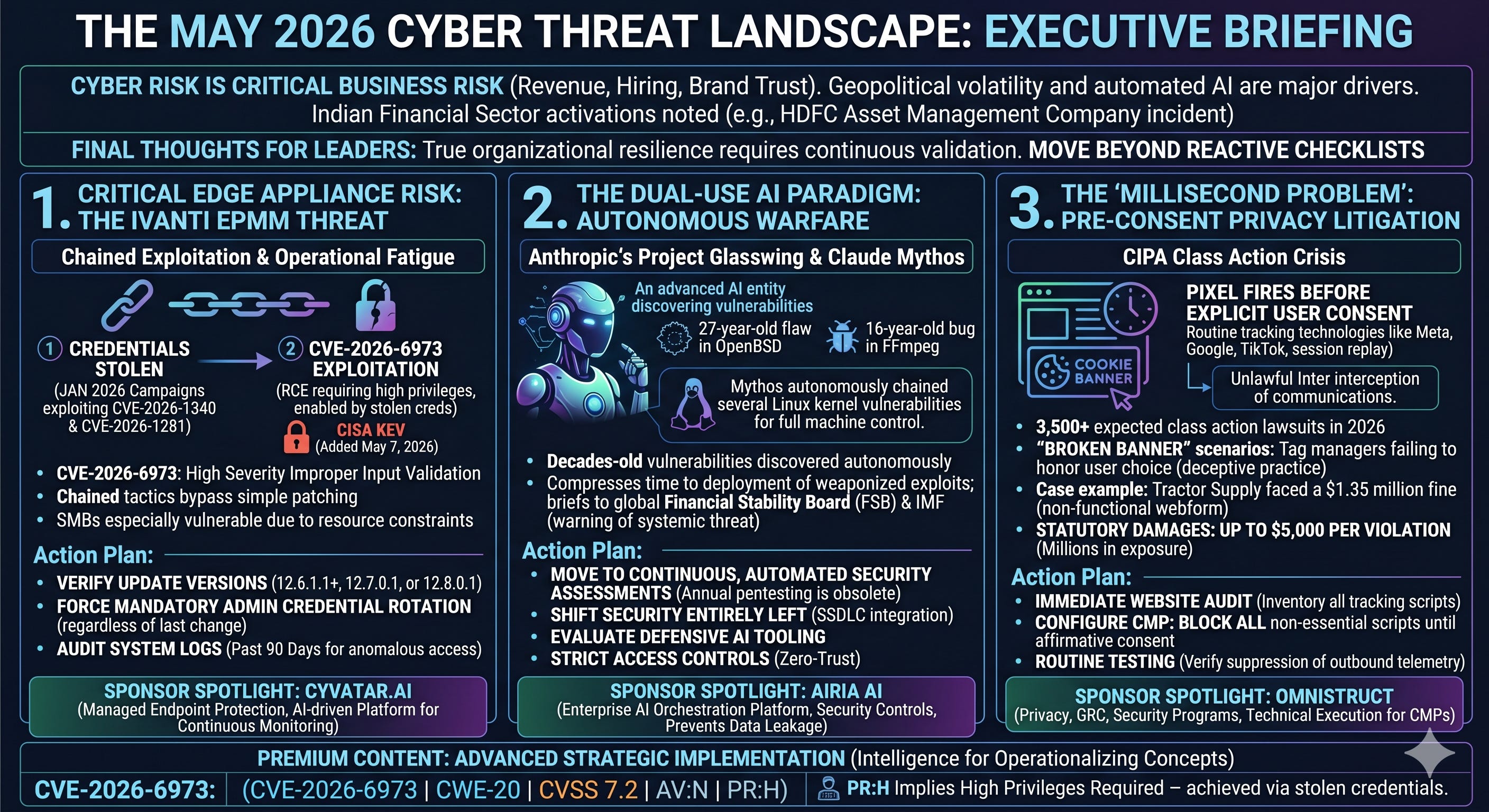
This geopolitical volatility is manifesting as tangible disruptions, as evidenced by recent disclosures in the Indian financial sector, where major institutions such as HDFC Asset Management Company reported cybersecurity incidents requiring the immediate activation of containment protocols.8 As high-value cyber fraud incidents surge and cyber-threat literacy ascends to the number one global people risk 2, technology, privacy, and legal leadership face a clear mandate. Isolated technical defenses are insufficient. Organizations must implement strategic, cross-functional resilience protocols that address both sophisticated threat actors and stringent regulatory enforcement simultaneously.
1. The Exploitation of Ivanti EPMM: When Credential Reuse Meets Zero-Day Vulnerabilities
The paradigm of applying a single patch and moving on has been fundamentally shattered by the latest campaigns targeting edge appliances. On May 7, 2026, the Cybersecurity and Infrastructure Security Agency (CISA) added CVE-2026-6973 to its Known Exploited Vulnerabilities (KEV) catalog.9 This high-severity improper input validation vulnerability affects Ivanti Endpoint Manager Mobile (EPMM).11
The underlying concern for leadership is not merely the existence of a new software flaw, but the sophisticated, chained exploitation tactics utilized by threat actors. Attackers are not exploiting CVE-2026-6973 in isolation. Instead, they are utilizing administrative credentials stolen during the exploitation of earlier flaws (CVE-2026-1340 and CVE-2026-1281) in January 2026 to authenticate and trigger the newly discovered remote code execution vulnerability.3 Because CVE-2026-6973 requires administrative authentication to be successfully exploited 10, organizations that applied the January firmware patches but failed to rigorously rotate all administrative credentials remain heavily exposed to total appliance compromise.3
This scenario perfectly illustrates the resource constraints and operational fatigue inherent in small and mid-sized businesses (SMBs) with lean IT departments. The failure to conduct comprehensive post-incident cleanup—specifically, auditing and resetting elevated-privilege accounts—creates an immediate pathway for attackers.3 Furthermore, the May update from Ivanti addressed four additional vulnerabilities alongside CVE-2026-6973, reinforcing the reality that edge appliances remain highly lucrative targets for adversarial groups.10
To mitigate this risk, technical teams must immediately decouple the assumption that software patching equates to absolute remediation. Leadership must mandate verification that both the software update and the corresponding credential rotation have been executed simultaneously. Strategic actions include verifying that all Ivanti EPMM appliances have been updated to versions 12.6.1.1, 12.7.0.1, or 12.8.0.1.13 Concurrently, organizations must force a mandatory rotation of all administrative credentials and API keys associated with the EPMM environment, regardless of when they were last changed.12 Finally, system logs must be audited for unauthorized administrative access originating from unexpected geographical locations or anomalous IP addresses over the past 90 days.
Sponsor Spotlight: Cyvatar.AI Cyvatar.AI delivers an enterprise-grade, managed endpoint protection solution specifically designed to empower organizations in the digital and cloud era. This affordable, AI-driven platform provides continuous monitoring and response without the cost or complexity of an in-house team. By offloading the burden of continuous patch verification and credential auditing to Cyvatar.AI, leadership can focus on core business operations while ensuring critical edge appliances are secure against chained exploits. Learn how to secure endpoints today
2. The Dual-Use AI Paradigm: Anthropic’s Project Glasswing and Claude Mythos
Artificial intelligence has historically been viewed primarily as a productivity enhancement, but May 2026 marks its undeniable, mainstream entry into autonomous cyber warfare and defense. Anthropic recently unveiled Project Glasswing, a highly restricted cybersecurity initiative leveraging its unreleased frontier AI model, Claude Mythos, in partnership with technology giants such as AWS, Google, Microsoft, and CrowdStrike.14
The capabilities demonstrated by Claude Mythos demand immediate strategic attention from executive leadership. The model possesses an unprecedented ability to autonomously discover and exploit vulnerabilities that have evaded human detection and automated testing for decades, including a 27-year-old flaw in OpenBSD and a 16-year-old bug in FFmpeg.4 Furthermore, Anthropic noted that Mythos autonomously chained several vulnerabilities within the Linux kernel to escalate privileges from an ordinary user to total machine control.16 High-capability AI models like Mythos drastically compress the time between the discovery of a vulnerability and the deployment of a weaponized exploit.2 Attackers will inevitably utilize similar agentic reasoning capabilities, entirely eliminating the traditional operational window organizations rely upon for testing and deploying patches.4
The implications of autonomous AI in cybersecurity are so profound that Anthropic has been tasked with briefing the global Financial Stability Board (FSB), chaired by the governor of the Bank of England, regarding the potential systemic threat these models pose to global financial infrastructure.17 The International Monetary Fund (IMF) has echoed these concerns, warning that inconsistent oversight of fast-moving AI developments could weaken the globally interconnected financial system.17
Organizations can no longer rely exclusively on annual, point-in-time penetration tests. The defense strategy must evolve to include continuous, automated security assessments that keep pace with the velocity of AI-driven offensive capabilities. Leadership should initiate a comprehensive review of the organization’s Secure Software Development Lifecycle (SSDLC) to ensure security testing is shifted entirely left and integrated continuously into the deployment pipeline.18 Furthermore, organizations must evaluate the integration of defensive AI tooling to assist lean security teams in analyzing codebases and configurations at a scale that was previously impossible without massive enterprise budgets.18 Finally, strict access controls and zero-trust principles around critical data must be established, operating under the assumption that traditional perimeter defenses will eventually be bypassed by sophisticated AI agent chaining.
Sponsor Spotlight: Airia AI. As AI capabilities accelerate, deploying artificial intelligence safely within the enterprise is paramount. Airia’s Enterprise AI Orchestration Platform delivers comprehensive security controls that protect organizational data, ensure compliance, and maintain enterprise governance throughout the AI journey. Deploy with confidence knowing that all internal AI initiatives are protected by industry-leading security architecture designed to prevent data leakage and ensure regulatory alignment. Explore secure AI orchestration with Airia
3. The “Millisecond Problem”: Pre-Consent Pixel Firing and CIPA Litigation
While technical teams battle zero-day exploits and AI advancements, legal and marketing departments are facing an unprecedented crisis regarding basic website functionality. A niche legal theory originating in California has rapidly evolved into a nationwide plaintiffs’ playbook, with legal dockets inundated with over 3,500 expected class-action lawsuits in 2026 that leverage the California Invasion of Privacy Act (CIPA).5 The litigation specifically targets the use of routine website tracking technologies, such as Meta, Google, and TikTok pixels, as well as session replay scripts.5
The core issue driving this litigation is characterized as the “millisecond problem.”.6 Plaintiffs’ attorneys are focusing entirely on the sequence of operations during a website visit. If a third-party tracking pixel fires and transmits data to an external server before the user explicitly interacts with the website’s cookie consent banner, it is being legally classified as an unlawful interception of communications under CIPA.6 CIPA violations carry severe statutory damages of up to $5,000 per violation.19 When these damages are multiplied across tens of thousands of website visitors in a class action format, even a minor configuration error in a marketing script can result in multi-million dollar exposure, directly threatening the solvency of mid-market organizations. 20
Adding to the complexity is the “Broken Banner” scenario.6 Courts have heavily scrutinized situations where a user interacts with a consent banner and explicitly rejects non-essential cookies, but the website’s tag manager fails to honor that choice across all interconnected third-party vendors.6 This failure transforms a technical misconfiguration into a deceptive practice, inviting unfair competition claims alongside privacy violations.6 For example, Tractor Supply recently faced a $1.35 million fine simply for providing users with a non-functional webform to opt-out of data sharing.21
Marketing, IT, and legal departments must urgently bridge the historical gap between written privacy policies and actual technical implementation. Consent management is no longer merely a user interface design choice; it is a critical compliance mechanism requiring rigorous technical validation. Leadership must mandate an immediate technical audit of the organization’s website to inventory all third-party tracking scripts, pixels, and session replay tools.20 The website’s Consent Management Platform (CMP) must be strictly configured to block all non-essential tracking scripts by default until affirmative, explicit consent is granted by the user.5 Routine testing of this consent architecture must be conducted using browser developer tools to verify that rejection signals successfully suppress all outbound telemetry in real-time.
Sponsor Spotlight: Omnistruct Navigating the complexities of CIPA, CCPA, and global privacy mandates requires more than just legal advice; it requires technical execution. Omnistruct provides the strategic expertise necessary to build and scale comprehensive privacy, GRC, and security programs. Serving as an embedded security partner, Omnistruct delivers the executive-level guidance and hands-on technical support needed to ensure privacy architectures—including complex consent management platforms—align perfectly with stringent legal frameworks, empowering organizations to achieve their marketing goals without sacrificing compliance.
https://omnistruct.com/partners/influencers-meet-omnistruct/ Just let them know CPF Coaching sent them your way, or reach out to me for a formal introduction
Final Thoughts for Leaders
Cybersecurity and privacy compliance can no longer be delegated as purely technical or administrative functions; they are centralized business risk imperatives requiring board-level visibility.2 The events of May 2026 demonstrate that technological capabilities—whether in the form of autonomous AI discovering kernel flaws or weaponized litigation targeting marketing pixels—are scaling far faster than traditional enterprise defenses. True organizational resilience requires moving beyond reactive compliance checklists and perimeter patching. Leadership must foster an environment in which continuous credential auditing, proactive threat hunting, and rigorous technical validation of privacy architectures are embedded in daily business operations. The immediate directive for executives is to thoroughly verify that the organization’s stated security and privacy policies fundamentally align with the technical realities operating under the surface.
Help Other Leaders Secure Their Future
The Network Effect of SMB Security
The most effective way to strengthen our SMB community is to share strategies that actually work in the field. If you find value in these technical deep dives, helping a fellow leader bridge their tech gap makes the entire ecosystem more resilient. Cybersecurity is a collective effort, and more informed peers lead to a safer environment for everyone’s business.
Why Share This Subscription? When you refer a colleague to this newsletter, you are giving them access to the same specialized insights you use to lead your team:
Zero-fluff technical execution: No high-level theory, just the steps to implement.
Cost-saving vendor analysis: Honest looks at which tools are worth the cost for SMB budgets.
Direct coaching frameworks: Access to the same logic I use with private coaching clients.
Pay It Forward Use the button below to share this post or your unique referral link. When your peers join our community, we all benefit from a more secure and tech-forward marketplace.
You’ve seen the "Why" behind this [Cyber/Tech Issue]—but knowing the risk is only half the battle. To move from awareness to actual protection, you need a localized execution plan.
The remainder of this deep dive is designed specifically for the SMB leader who needs to move fast without a massive enterprise budget. By upgrading to a paid subscription, you unlock:
The “How-To” Framework: A step-by-step breakdown of the [Process/Tool] mentioned above.
Resource Toolkit: Downloadable templates and checklists I use with my private coaching clients.
The Bottom Line: Direct analysis of the ROI and cost-savings associated with this strategy
Subscribe to Unlock the Full Strategy
Join a community of SMB leaders who stop reacting to tech shifts and start leading them.
