
Infostealers, HIPAA Fallout, and Computer-Using AI
What SMB leaders should verify now before credentials, regulators, or agents move faster than your controls.

On June 24, 2026, (Sorry, this one slipped through the cracks) Microsoft said its Digital Crimes Unit, working with Europol and industry partners, moved to disrupt more than 200 malicious StealC and Amadey command-and-control domains and IP addresses. Six days earlier, on June 18, 2026, HHS’ Office for Civil Rights announced a $450,000 HIPAA settlement after a ransomware incident at a health plan that potentially affected 10,023 people. Then, on June 24, 2026, Google said computer use is now built directly into Gemini 3.5 Flash, giving teams a mainstream path to AI that can see, reason, and take action across browser, mobile, and desktop environments.
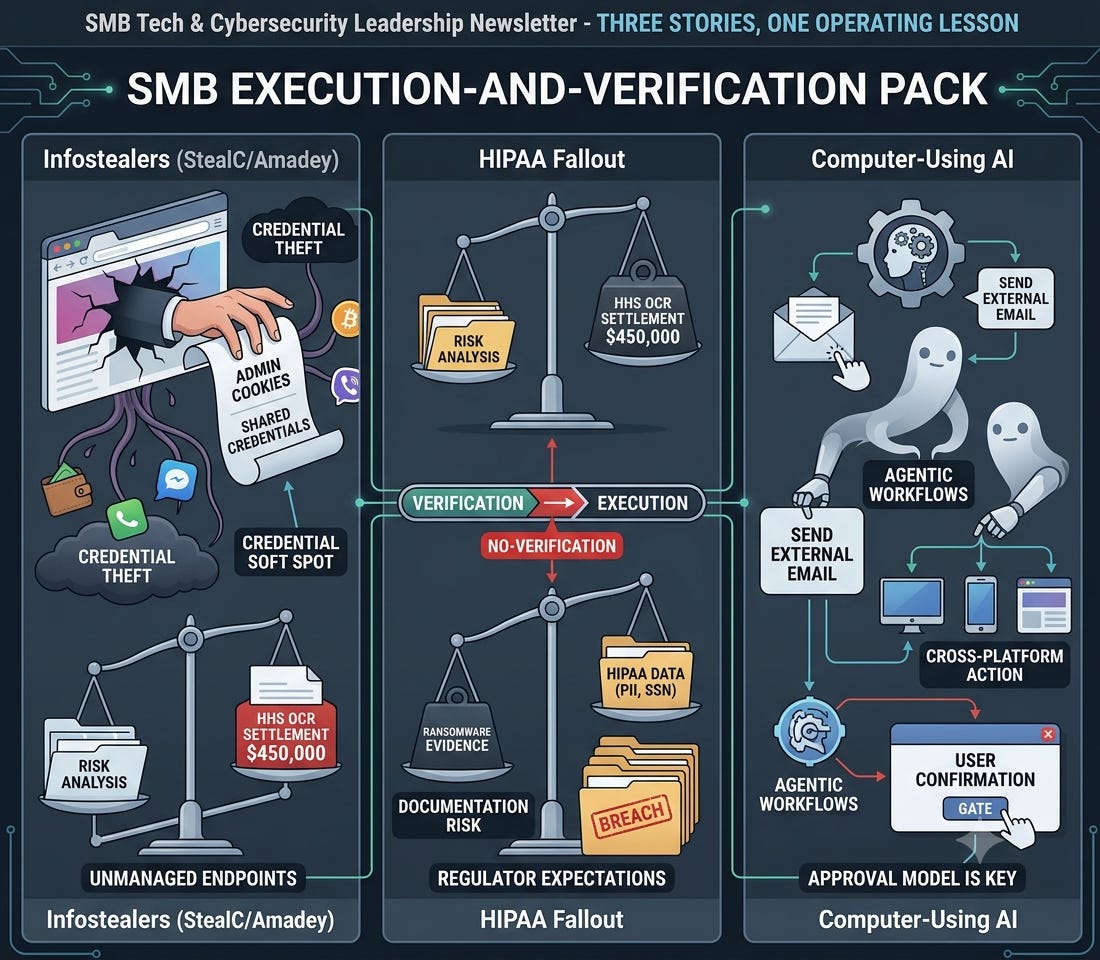
These are not separate stories. They are one operating lesson told from three angles. The software you trust can steal. The workflows you postpone can become regulatory evidence. And the AI you pilot for convenience can cross the line from draft help to real execution faster than your approval model catches up. If you lead an SMB with limited staff and a long tool list, the real question this week is simple: what inside your business can act before a human verifies it?
Infostealers Are Still Feeding Bigger Attacks
Microsoft said StealC is an infostealer that collects sensitive data from browsers, cryptocurrency wallets, messaging applications, email clients, and gaming platforms, while Amadey acts as a loader that can deliver StealC and other malware. Microsoft also said the disruption action on June 24 targeted more than 200 malicious domains and IPs tied to that infrastructure. The leadership takeaway is not only that one family got hit. It is that the credential-theft economy remains fast, modular, and commercially packaged.
Why You Should Be Concerned:
Credential theft is still the bridge to bigger damage: Microsoft explicitly tied infostealers to access brokers and downstream ransomware or follow-on operations.
The first infection can start outside your most managed systems: Microsoft warned that defenders may only notice the breach after valid credentials are already being abused.
Browsers and user tools remain a soft spot: When browsers, email clients, and chat apps become collection points, a single compromised endpoint can lead to a broader identity problem.
Strategic Action: Treat browser-stored access, local endpoints, and admin sessions as one control surface. If you are still separating endpoint protection from identity protection and browser hygiene, you are leaving too much room between infection and detection.
Three steps to take this week:
Revoke or rotate privileged sessions, admin cookies, and high-value credentials stored or recently used on unmanaged or lightly managed endpoints.
2. Confirm that every leader, finance user, and administrator is using managed endpoint protection and a password or passkey workflow that limits credential sprawl in the browser.
3. Review which SaaS admin accounts still allow broad access from a single endpoint without step-up verification or conditional access.
If your browser, email, and admin sessions are all one infostealer away from becoming an attacker’s launchpad, Bitdefender is a strong fit for SMB teams that need tighter endpoint visibility, isolation, and response coverage without building a large internal security operation.
Regulators Still Expect You to Show Your Work After Ransomware
HHS OCR said the ransomware investigation started after a health plan reported a breach tied to unauthorized access in November 2021. According to OCR, 10,023 individuals were potentially affected, and the plan paid $450,000 while agreeing to a two-year corrective action plan. OCR said the plan potentially failed to conduct an accurate and thorough risk analysis before the incident and failed to implement reasonable and appropriate policies and procedures under the HIPAA Privacy, Security, and Breach Notification Rules.
Why You Should Be Concerned:
Ransomware response is also a documentation risk: OCR did not stop at the breach itself. It focused on what the organization could not prove it had already assessed and implemented.
The data set matters: OCR said names, addresses, phone numbers, email addresses, and Social Security numbers were potentially affected, which raises both operational and trust costs.
Regulators spelled out the control expectations: OCR specifically highlighted risk analysis, audit controls, system activity review, authentication, encryption, incident lessons learned, and workforce training.
Strategic Action: Stop assuming your controls are real because they are familiar. I recognize many SMB teams are stretched thin and rely on a handful of people to cover IT, privacy, and security at once. That is exactly why you need an evidence trail that survives a bad week.
Three steps to take this week:
Map where regulated or otherwise high-sensitivity data enters, moves through, and leaves your systems, even if you are not a full-scale healthcare organization.
Document one current risk analysis for your most sensitive workflow instead of waiting for the perfect enterprise-wide assessment.
Verify that audit logging, authentication controls, encryption decisions, and workforce training are not just assumed but named, owned, and reviewable.
AFTER RANSOMWARE, “WE THOUGHT WE HAD IT COVERED” IS NOT A CONTROL.
OCR’s June 18 settlement shows that enforcement attention lands on the evidence behind your safeguards, not just your incident narrative. If risk analysis, policy maintenance, and control ownership still live across scattered documents and tribal knowledge, the cleanup cost goes up fast.
Copla is well matched for teams that need compliance automation, evidence collection, and expert support across frameworks without rebuilding the whole program from scratch.
Turn policy into proof. Review Copla here
Computer-Using AI Is Becoming a Real Operations Design Choice
Google said on June 24, 2026, that computer use is now a built-in tool in Gemini 3.5 Flash. Google said this lets developers build agents that can interact across browser, mobile, and desktop environments, and specifically framed the capability as a better fit for long-horizon automation tasks such as continuous software testing and knowledge work across professional applications. Google also said the release includes safeguards that can require explicit user confirmation for sensitive or irreversible actions and can automatically stop a task when indirect prompt injection is detected.
Why You Should Be Concerned:
This shifts AI from generation to action: Google is packaging computer use inside a mainstream model, not as a niche experiment.
The risk language is already in the launch copy: Prompt injection, sensitive actions, and the need for human-in-the-loop verification were central to Google’s own safety framing.
Your approval model now matters more than your model demo: When AI can click, navigate, and act across tools, the governance question becomes operational rather than hypothetical.
Strategic Action: Define where AI may advise, where it may draft, and where it may act only with approval. If a team cannot explain the trigger, owner, data boundary, and rollback for an agentic workflow, the workflow is not ready for production.
Three steps to take this week:
Pick one low-risk workflow where AI can act in a bounded environment and document the exact success condition, stop condition, and human approver.
2. Require confirmation for spending, external communication, security changes, and record updates rather than leaving those actions to default agent behavior.
3. Log every pilot with the tool used, systems touched, data involved, owner, and rollback path before expanding access.
Final Thoughts for Leaders
The common thread this week is execution without verification. Infostealers exploit it, regulators punish its absence, and AI that uses computers makes it easy to scale. Your job is no longer just to choose better tools. It is to decide which actions require proof, which systems can act alone, and which identities or agents need tighter boundaries before they can move. Put endpoint credential hygiene, risk-analysis evidence, and AI approval rules on your next leadership agenda before this week ends.
Help Other Leaders Secure Their Future
The Network Effect of SMB Security
The most effective way to strengthen our SMB community is to share strategies that actually work in the field. If you find value in these technical deep dives, helping a fellow leader bridge their tech gap makes the entire ecosystem more resilient. Cybersecurity is a collective effort, and more informed peers lead to a safer environment for everyone’s business.
Why Share This Subscription? When you refer a colleague to this newsletter, you are giving them access to the same specialized insights you use to lead your team:
Zero-fluff technical execution: No high-level theory, just the steps to implement.
Cost-saving vendor analysis: An honest look at which tools are worth the cost for SMB budgets.
Direct coaching frameworks: Access to the same logic I use with private coaching clients.
Pay It Forward. Use the button below to share this post or your unique referral link. When your peers join our community, we all benefit from a more secure and tech-forward marketplace.
You’ve seen the "Why" behind this [Cyber/Tech Issue]—but knowing the risk is only half the battle. To move from awareness to actual protection, you need a localized execution plan.
The remainder of this deep dive is designed specifically for the SMB leader who needs to move fast without a massive enterprise budget. By upgrading to a paid subscription, you unlock:
The “How-To” Framework: A step-by-step breakdown of the [Process/Tool] mentioned above.
Resource Toolkit: Downloadable templates and checklists I use with my private coaching clients.
The Bottom Line: Direct analysis of the ROI and cost-savings associated with this strategy
Subscribe to Unlock the Full Strategy
