

SMB Risk Briefing: Lock the Controllers, Unify the Evidence, and Modernize AI with Real Ownership
Three practical signals from July 17 through July 22, 2026: updated U.S. government guidance on Iranian-affiliated PLC targeting, a fresh European push for cross-regulatory privacy enforcement, and OpenAI's new small-business AI program.

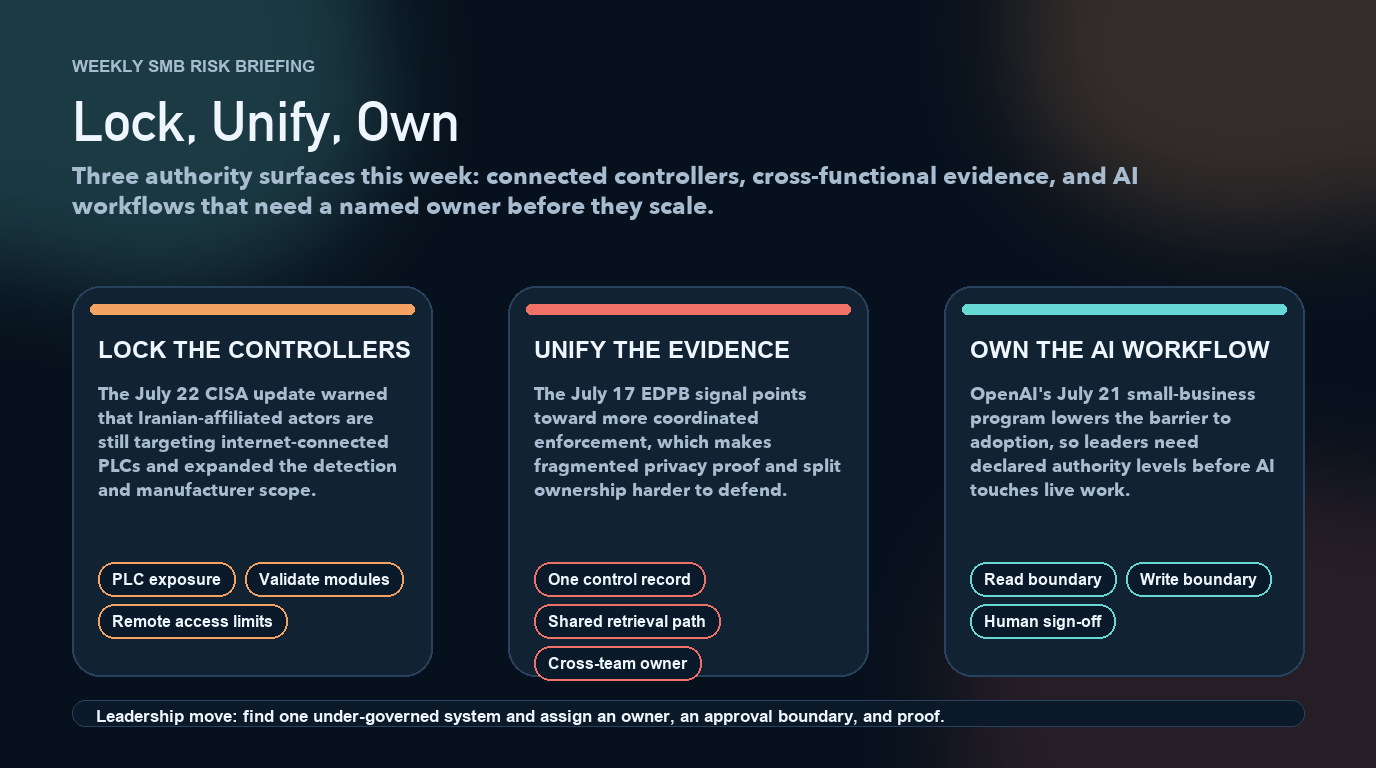
If you want a useful way to read this week, do not sort the news into neat boxes labeled cyber, privacy, and AI. The more relevant pattern is authority. On Tuesday, July 22, 2026, CISA, the FBI, the EPA, and other U.S. partners updated their warning about Iranian-affiliated actors targeting internet-connected programmable logic controllers across U.S. critical infrastructure, including local municipalities and water systems. Five days earlier, on Friday, July 17, the European Data Protection Board said regulators need a clearer legal basis to share information across adjacent enforcement domains because complaint volume and complexity are rising, including from the increased use of AI. One day before the CISA update, on Monday, July 21, OpenAI launched a new small business program built around ChatGPT Work, training, AI academies, and partner workflows for lean teams.
Those are three different domains, but they expose the same leadership problem. A controller can quietly influence operations. A fragmented evidence trail can weaken your compliance posture when regulators coordinate. And a promising AI workflow can spread faster than your approval model. If the system has real authority, you need a named owner, a boundary, and proof that the control works the way you think it does
1. Internet-Connected Controllers Are Still a Live Operational Threat
On July 22, 2026, CISA, the FBI, the EPA, and other U.S. government partners updated their advisory on Iranian-affiliated actors targeting programmable logic controllers across U.S. critical infrastructure. The update added guidance for detecting malicious changes in reusable code modules used within Rockwell Automation PLC programs and expanded the observed manufacturer scope to Schneider Electric, Siemens, and possibly others. The advisory also reinforced a basic but uncomfortable truth: internet-connected operational technology still creates direct business risk when organizations leave access exposed or treat industrial control paths like background infrastructure.
Why you should be concerned: This is not just a large-utility story. Many SMBs operate small plants, warehouses, building-management systems, water-facing environments, municipal systems, or vendor-managed industrial assets that sit one step away from physical operations. When adversaries can manipulate HMI or SCADA-facing data, the impact is not abstract. It can become operational disruption, financial loss, and a messy incident narrative about why remotely reachable systems were left in a fragile state.
Strategic action: Stop treating connected controllers as someone else’s black box. Whether you own the asset directly or rely on an MSP, integrator, landlord, or facilities vendor, your leadership team still needs a current answer to a simple question: which control systems are reachable, who approves changes, and how would you know if code or project files were altered?
Three steps to take this week:
Inventory any internet-connected controller, building-management, or industrial device path your business relies on, including vendor-managed environments and municipal or landlord dependencies.
Confirm whether direct internet exposure exists anywhere in those environments and whether remote access is constrained to approved management paths.
Ask for proof that controller logic, reusable modules, and project files can be validated against unauthorized changes instead of assuming the vendor would tell you.
Partner resource: Bitdefender is a strong fit when you need better endpoint visibility, network-risk reduction, and incident support around the broader Windows, admin, and remote-access surfaces that usually sit next to these operational systems. Affiliate note: CPF Coaching may earn a commission if you choose to use it.
2. Regulators Are Signaling More Joined-Up Enforcement
On July 17, 2026, the European Data Protection Board called for a clear legal basis for cross-regulatory information sharing and said regulators are dealing with rising complaint volume and complexity, including pressure created by AI-related issues. The practical significance is larger than the policy language might suggest. Privacy enforcement is becoming more coordinated, more operational, and less tolerant of fragmented evidence held separately across legal, security, product, marketing, and vendors.
Why you should be concerned: A lot of SMB compliance posture still depends on local heroics. The privacy notice lives in one system, the cookie or tag configuration lives in another, security logs live somewhere else, and vendor commitments sit in inboxes or procurement folders. That arrangement works until a complaint, breach, investigation, or customer challenge forces you to reconstruct the story quickly. Once regulators share information more easily across domains, disconnected controls become a liability, not just an inconvenience.
Strategic action: Build evidence the way a reviewer would need to see it, not the way internal teams happen to store it. If your business collects personal data, uses third-party tools, or changes digital experiences frequently, you need a simple, reviewable record of what the business says, what the systems do, who owns the control, and where the evidence lives.
Three steps to take this week:
Choose one live data-processing workflow and map the current evidence trail across notice, consent or disclosure, vendor dependencies, security logging, and owner accountability.
Identify where the story breaks because proof is split across teams, inboxes, tools, or contractors.
Create one shared control record that ties together policy, implementation owner, validation cadence, and retrieval path for evidence.
Partner resource: Copla is worth evaluating when privacy, security, and compliance work keeps stalling between advisory language and real operational follow-through. Affiliate note: CPF Coaching may earn a commission if you choose to use it.
3. Small-Business AI Is Getting Easier to Start and Harder to Govern Casually
On July 21, 2026, OpenAI launched the ChatGPT for small business program and positioned ChatGPT Work as an accessible way for small businesses to use training, guided workflows, partner integrations, and agents to complete multi-step work. The pitch is understandable. Lean teams want leverage. Owners do wear too many hats. But the leadership question is not whether AI can help. It is whether the workflow you are about to accelerate has a clear owner, a safe data boundary, and a defined approval model.
Why you should be concerned: Small-business AI adoption is leaving the experimentation phase. The moment an owner can connect files, apps, memory, prompts, and multi-step automation into something that influences sales, operations, finance, HR, or customer communication, the workflow stops being a harmless assistant experiment. It becomes part of the operating model.
Strategic action: Modernize with explicit ownership instead of enthusiasm alone. If you want AI to save time, great. If you want it to draft, route, analyze, or trigger work across core business systems, define the authority boundary first. Decide what the workflow may read, what it may write, what it may suggest, what it may send, and what still needs a named human sign-off.
Three steps to take this week:
Pick one existing AI workflow and classify it as advisory only, draft and review, or permissioned execution.
Document the connected systems, the sensitive data involved, and the exact point where human approval is still required.
Reject any rollout that cannot explain how errors are caught, how actions are logged, and how the workflow is disabled if it behaves unpredictably.
Partner resource: Airia is relevant when your goal is governed AI adoption with clearer workflow boundaries, visibility, and operational control instead of ad hoc sprawl. Affiliate note: CPF Coaching may earn a commission if you choose to use it.
Final Thoughts
This week is less about panic than about control design. A controller should not be quietly reachable. A compliance record should not need detective work. An AI workflow should not gain authority by convenience. The common thread is that modern systems collect power faster than most leadership models adapt.
If you only do one thing before next week, do this: identify one system in your business that can influence operations, evidence, or decisions more than your current oversight model deserves. Then name the owner, define the approval boundary, and demand proof that the control works.
Help Other Leaders Secure Their Future
The Network Effect of SMB Security
The most effective way to strengthen our SMB community is by sharing the strategies that actually work in the field. If you find value in these technical deep dives, helping a fellow leader bridge their tech gap makes the entire ecosystem more resilient. Cybersecurity is a collective effort and more informed peers lead to a safer environment for everyone’s business.
Why Share This Subscription? When you refer a colleague to this newsletter, you are giving them access to the same specialized insights you use to lead your team:
Zero-fluff technical execution: No high-level theory, just the steps to implement.
Cost-saving vendor analysis: Honest looks at which tools are worth the SMB budget.
Direct coaching frameworks: Access to the same logic I use with private coaching clients.
Pay It Forward Use the button below to share this post or your unique referral link. When your peers join our community, we all benefit from a more secure and tech-forward marketplace.
You’ve seen the "Why" behind this [Cyber/Tech Issue]—but knowing the risk is only half the battle. To move from awareness to actual protection, you need a localized execution plan.
The remainder of this deep dive is designed specifically for the SMB leader who needs to move fast without a massive enterprise budget. By upgrading to a paid subscription, you unlock:
The “How-To” Framework: A step-by-step breakdown of the [Process/Tool] mentioned above.
Resource Toolkit: Downloadable templates and checklists I use with my private coaching clients.
The Bottom Line: Direct analysis of the ROI and cost-savings associated with this strategy
Help Other Leaders Secure Their Future
The Network Effect of SMB Security
The most effective way to strengthen our SMB community is by sharing the strategies that actually work in the field. If you find value in these technical deep dives, helping a fellow leader bridge their tech gap makes the entire ecosystem more resilient. Cybersecurity is a collective effort and more informed peers lead to a safer environment for everyone’s business.
Why Share This Subscription? When you refer a colleague to this newsletter, you are giving them access to the same specialized insights you use to lead your team:
Zero-fluff technical execution: No high-level theory, just the steps to implement.
Cost-saving vendor analysis: Honest looks at which tools are worth the SMB budget.
Direct coaching frameworks: Access to the same logic I use with private coaching clients.
Pay It Forward: Use the button below to share this post or your unique referral link. When your peers join our community, we all benefit from a more secure and tech-forward marketplace.
Subscribe to Unlock the Full Strategy
Join a community of SMB leaders who stop reacting to tech shifts and start leading them.
Premium Implementation Guidance
Premium readers get the operating layer: how to turn this week’s three signals into a compact control model that can survive a real incident, a regulator question, or an overly ambitious automation rollout.
1. Control-Surface Triage for Operational Technology and Connected Facilities
Technical detail: The July 22 CISA update matters because it moved beyond a narrow manufacturer assumption and added guidance around malicious changes in reusable code modules, internet-connected PLC deployment, and direct OT exposure. Even when a small business does not think of itself as industrial, the practical risk can still sit in building systems, facilities contractors, smart infrastructure, warehouses, healthcare-adjacent equipment, or municipal dependencies.
Actionable strategy:
- Build a control-surface inventory covering PLCs, building controls, remote-access gateways, HMI consoles, SCADA dependencies, and vendor-managed operational assets.
- Separate business ownership from technical administration so someone accountable exists even when the equipment is managed by an outside party.
- Treat change validation as part of business continuity, not just engineering hygiene.
Leadership focus areas:
- Which internet-connected systems could disrupt operations even if they are not part of the traditional IT inventory?
- Which vendors or contractors can remotely touch those systems, and what logging or approval path exists?
- Which assets would create the highest operational pain if manipulated for even a short period?
2. Privacy Evidence Design for a More Coordinated Regulatory Environment
Technical detail: The EDPB’s July 17 message is a process signal: regulators want more efficient cross-regulatory information sharing, and they explicitly noted the growing volume and complexity of complaints, including those shaped by AI. The risk for SMBs is not that every regulator suddenly appears at once. It is that fragmented governance becomes easier to notice and harder to defend.
Actionable strategy:
- Create one reviewable evidence packet for each material workflow that touches personal data.
- Tie together the notice or disclosure, live implementation, responsible owner, validation cadence, vendor involvement, and retrieval path for logs or screenshots.
- Rehearse what you would produce within one hour if a customer, insurer, regulator, or board member asked how the workflow is governed.
Control focus areas:
- Which workflows depend on vendor promises that the business has not independently validated?
- Where would your team lose time because evidence is split across legal, marketing, IT, or contractors?
- Which AI-enabled or analytics-heavy changes could quietly outpace the privacy documentation supporting them?
3. AI Modernization with Declared Authority Levels
Technical detail: The July 21 OpenAI program is useful because it lowers the friction for small-business adoption. That is exactly why governance matters more, not less. Once lean teams can combine memory, connected apps, agents, prompts, and partner workflows, the organization needs a declared authority model for AI just like it has for finance approvals or security changes.
Actionable strategy:
- Classify each AI workflow by authority: recommend, draft, or execute.
- Require named approval before a workflow can send external communications, alter records, make customer-impacting decisions, or trigger live system changes.
- Log the workflow scope, connected tools, sensitive inputs, human reviewer, and rollback path.
Governance focus areas:
- Which AI workflows currently look low-risk only because nobody mapped their real data access?
- Which owners are assuming review will happen informally instead of being designed into the process?
- Which automation ideas should stay in draft mode until logging, escalation, and disablement are mature?
Premium Template: Authority and Evidence Control Record
Use this template for any system or workflow that can influence operations, personal data handling, or AI-assisted decisions.
System or workflow:
Business owner:
Technical owner:
Primary authority carried:
Connected systems or vendors:
Sensitive data involved:
What the system may read:
What the system may write or change:
What still requires human approval:
Validation cadence:
Evidence retained:
Incident or rollback path:
Next review date:
Premium Checklist: Friday Control-Surface Sweep
- [ ] Inventory any internet-connected controller, facilities, or vendor-managed operational system that could disrupt the business.
- [ ] Confirm whether direct internet exposure or unmanaged remote access exists for those systems.
- [ ] Choose one personal-data workflow and assemble its evidence trail in one place.
- [ ] Identify where privacy proof depends on multiple teams with no shared owner.
- [ ] Classify one AI workflow as advisory only, draft and review, or permissioned execution.
- [ ] Record the exact human approval step before the workflow can take meaningful action.
- [ ] Confirm logs, screenshots, or system records exist for the controls you claim to operate.
- [ ] Put one under-governed workflow on the next leadership agenda for cleanup.
Premium Exercise: The Quiet Authority Tabletop
Scenario: Your facilities vendor confirms that a remotely reachable controller was changed without a clearly documented approval. At the same time, a customer asks for evidence about how a data-processing workflow is governed, and an AI assistant has been drafting follow-up messages using shared files that nobody formally approved it to access.
Exercise objectives:
1. Decide which issue gets contained first and who has authority to lead the response.
2. Prove what operational, privacy, and AI-governance evidence the business can produce within one hour.
3. Identify where the organization granted authority by convenience instead of by design.
Questions to work through:
1. Which systems in your business currently hold more operational or evidentiary power than their oversight model deserves?
2. If a regulator or insurer asked for proof today, what could you retrieve immediately without relying on guesswork?
3. If an AI-enabled workflow caused a customer or operational problem, who would stop it, explain it, and prove the approval trail?
Sources
- CISA, FBI, EPA and partners, “CISA, FBI, EPA and U.S. Government Partners Update Warning of Iran-Affiliated Threat Actors Targeting Critical Infrastructure Programmable Logic Controllers,” released July 22, 2026: https://www.cisa.gov/news-events/news/cisa-fbi-epa-and-us-government-partners-update-warning-iran-affiliated-threat-actors-targeting
- European Data Protection Board, “EDPB calls for legal basis for cross-regulatory information sharing,” published July 17, 2026: https://www.edpb.europa.eu/news/edpb-calls-for-legal-basis-for-cross-regulatory-information-sharing_en
- OpenAI, “Introducing the ChatGPT for small business program,” published July 21, 2026: https://openai.com/index/introducing-chatgpt-small-business-program/