

SMB Risk Briefing: Patch the AI Edge, Tighten the Data Story, and Modernize with Authority
Three practical signals from July 30 through August 4, 2026: CISA's KEV escalation for Langflow, the EDPB and European Commission's work on data protection and competition law, and OpenAI's signal that AI is becoming part of how the business operates.

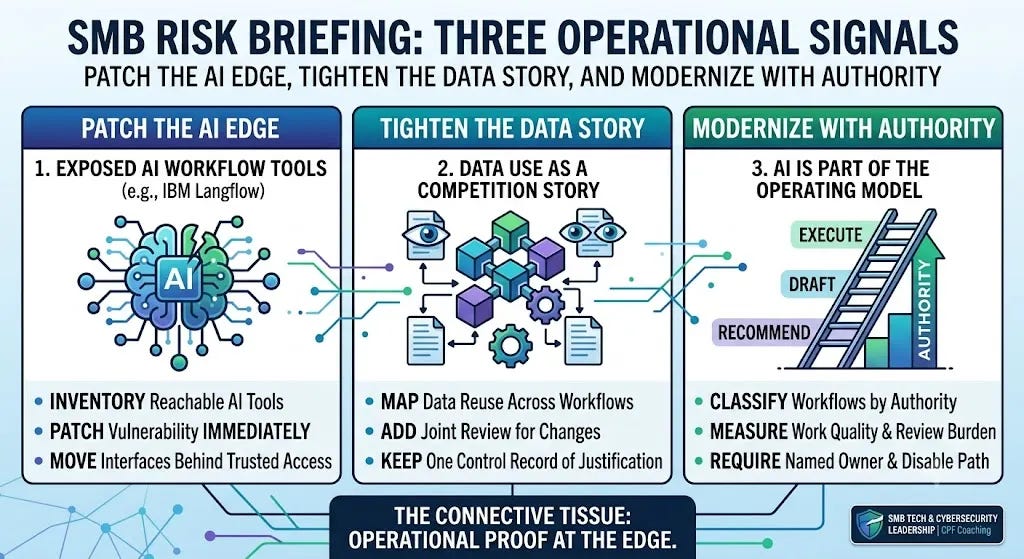
If you want a cleaner way to read this week, do not split the signals into separate piles called cyber, regulation, and AI. The more useful pattern is operational proof. On Monday, August 4, 2026, CISA added IBM Langflow’s code injection flaw to the Known Exploited Vulnerabilities Catalog after evidence of active exploitation. Five days earlier, on Thursday, July 30, the European Data Protection Board and the European Commission said they were organizing stakeholder input for upcoming guidelines on the interplay between competition and data protection. And on Sunday, August 3, OpenAI argued that as adoption spreads across functions, AI becomes part of how the business operates.
That combination matters because SMB leaders are granting authority through tooling faster than they are updating oversight. An exposed AI workflow tool can turn prompts, connectors, and stored secrets into remote code execution. A growth or bundling decision can become a privacy and competition question at the same time. And an AI workflow that starts as convenient assistance can quietly become part of execution without a named owner, review point, or rollback path. If a system can influence code, data reuse, or business action, it needs proof.
1. Exposed AI Workflow Tools Are Now a Straight Cyber Hygiene Problem
On August 4, 2026, CISA added three new flaws to its Known Exploited Vulnerabilities Catalog, including IBM Langflow’s code injection vulnerability, CVE-2026-9198. IBM’s own bulletin says default Langflow deployments from versions 1.0.0 through 1.10.0 allow unauthenticated attackers to chain an auto-login bypass with a code-validation endpoint and achieve full remote code execution. IBM also says there are no workarounds and strongly recommends upgrading to version 1.10.1.
Why you should be concerned: A lot of SMB AI tooling still lives in the “pilot” mental bucket even when it has real credentials, real documents, and real network reach. That is a mistake. A workflow tool that can read internal data, call downstream systems, or execute user-supplied code is not a harmless sandbox once it is reachable or connected. It is part of the attack surface.
Strategic action: Stop treating internal AI workflow tooling as exempt from production discipline. Inventory it. Patch it. Restrict it. Rotate any secret it could have exposed. The important leadership question is not “Was this only an experiment?” It is “What authority did this system already hold when we let it onto the network?”
Three steps to take this week:
Inventory every internet-reachable AI workflow, prompt engineering, low-code automation, notebook, or agent tool your business still has running, including internal demos that connect to real data.
Patch Langflow and any similar workflow tooling immediately, then rotate tokens, API keys, and stored credentials if the instance was exposed or its status is uncertain.
Move AI workflow interfaces behind trusted access paths, reduce administrator reach, and confirm that audit logs exist for configuration changes, code validation, and connector use.
Partner resource: Bitdefender is a strong fit when you need better endpoint, identity-adjacent, and threat-detection coverage around the systems that sit next to internal AI workflow tooling and business data.
Affiliate note: CPF Coaching may earn a commission if you choose to use it.
2. Data Use Is Becoming a Competition Story Too
On July 30, 2026, the EDPB and the European Commission announced a stakeholder event tied to their upcoming guidelines on the interplay between competition and data protection. The point is bigger than the event itself. Regulators are signaling that how companies combine, reuse, and leverage data across products and market positions cannot be treated as a siloed privacy question anymore.
Why you should be concerned: SMB leaders often separate growth decisions from data-governance decisions until the business gets bigger. But product bundling, customer-profile reuse, analytics enrichment, and integrated upsell flows can create a combined competition and privacy story long before a company thinks of itself as large enough to attract serious scrutiny. Once that story matters, disconnected documentation becomes a liability.
Strategic action: Build one reviewable record for meaningful data reuse decisions. If the same customer data is supporting multiple products, pricing decisions, partner relationships, or cross-sell motions, document the business purpose, the user expectation, the approval logic, and the evidence trail. Do not wait for a complaint or diligence request to reconstruct why the business thought the reuse was acceptable.
Three steps to take this week:
Map where the same customer or prospect data is reused across sales, marketing, customer success, analytics, and product workflows.
Add a joint review step whenever a change expands data reuse, product bundling, or cross-context profiling beyond the original workflow.
Keep one control record that shows what data is reused, why the business believes it is justified, who approved it, and how a customer or regulator challenge would be answered quickly.
Partner resource: Noted.Solutions helps compliance and RegTech teams explain controls, evidence expectations, and buyer trust more clearly. It fits best when the audience needs stronger GRC messaging, sharper stakeholder communication, or more usable compliance-facing content.
Affiliate note: CPF Coaching may earn a commission if you choose to use it.
3. AI Modernization Is Crossing from Experiment to Operating Model
OpenAI’s August 3, 2026 piece on “building abundant intelligence” makes one operating point especially clear: as people gain confidence in the technology, they use it more deeply, adoption spreads across functions, and AI becomes part of how the business operates. The post says OpenAI’s products now reach more than one billion active users and more than two million businesses, and it frames the shift from asking systems questions to using them for more complex, multistep work.
Why you should be concerned: Many SMB teams still measure AI maturity by usage volume, seat count, or how impressed people feel. That is the wrong control surface. The relevant question is authority. What can the workflow read? What can it draft? What can it send? What can it change? If AI is becoming part of how the business operates, then it needs promotion criteria, not just enthusiasm.
Strategic action: Modernize by authority level. Keep workflows in recommendation or draft mode until they have an owner, a review point, and a rollback path. Promote them into execution only when the business can explain how quality is measured, how errors are contained, and what proof exists that the workflow is behaving as intended.
Three steps to take this week:
Classify each live AI workflow as recommend, draft, or execute instead of describing it vaguely as “in use.”
Measure the useful work, review burden, and exception rate for each workflow before giving it more authority.
Require a named owner, logging, and a disable path before any workflow is allowed to send external communications, update business records, or trigger downstream tasks.
Partner resource: Airia is worth evaluating when your goal is governed AI adoption with clearer workflow boundaries, visibility, and operational control instead of ad hoc sprawl.
Affiliate note: CPF Coaching may earn a commission if you choose to use it.
Final Thoughts
The connective tissue this week is proof at the edge. An AI workflow tool should not be internet-exposed by accident. A data reuse decision should not live only in product ambition and scattered notes. And an AI workflow should not gain authority just because it feels useful. SMB leaders do not need more hype. They need clearer promotion rules for systems that influence the business.
If you only do one thing before next week, choose one AI-enabled or data-dependent workflow that currently has more authority than its documentation deserves. Then name the owner, define the review point, and ask for evidence that the control works right now.
Sharing is caring
Share this issue with another SMB leader who needs a cleaner authority model around operations, privacy evidence, or AI workflows.
Why not Subscribe
Join a community of leaders who want practical implementation guidance, not just headlines, when technology risk changes how their businesses operate.