


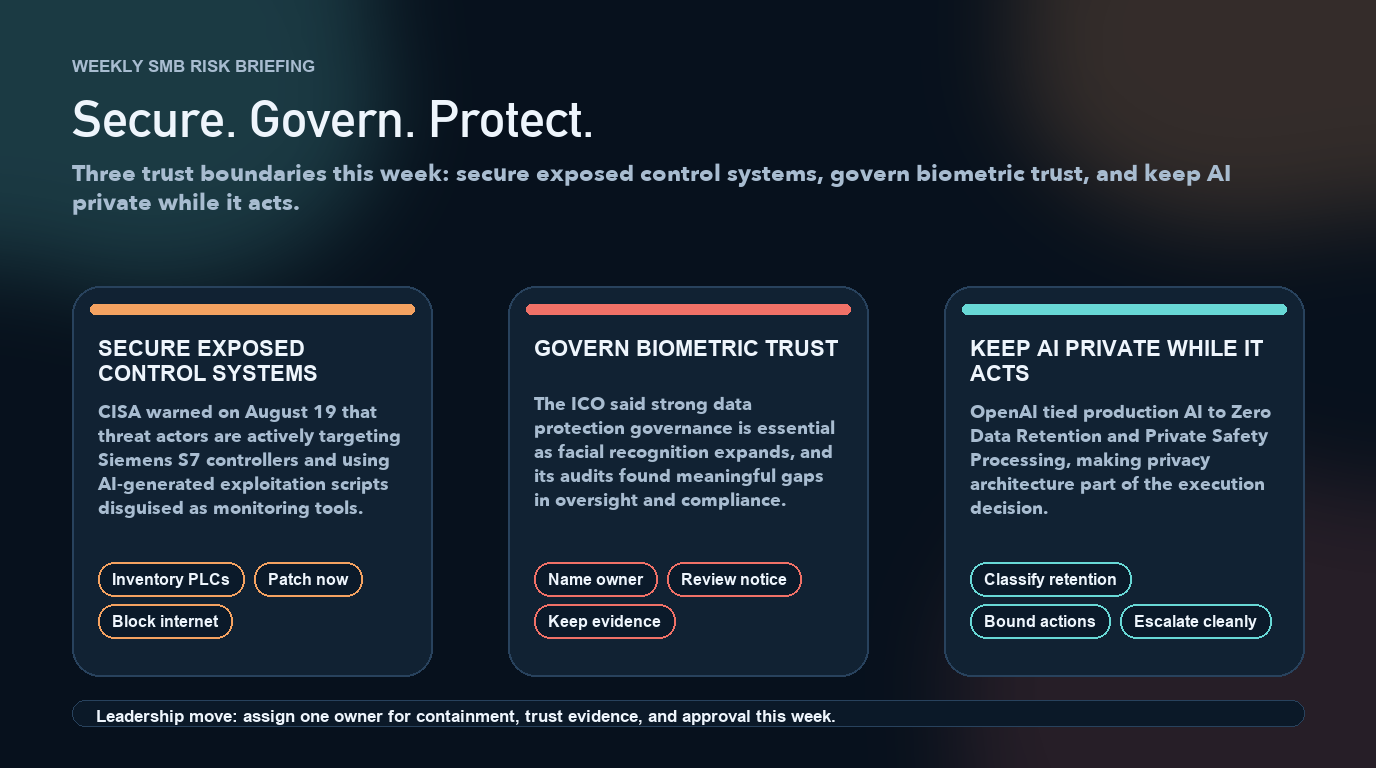
If your business still treats industrial control risk, biometric privacy, and enterprise AI privacy as separate conversations, this week offers a better frame. On Tuesday, August 18, 2026, the UK’s Information Commissioner’s Office said strong data protection governance is essential to public trust as facial recognition expands. One day later, on Wednesday, August 19, CISA, the NSA, the FBI, the Department of Energy, and the EPA warned that threat actors are actively targeting Siemens S7 Series PLCs, including with AI-generated exploitation scripts disguised as legitimate monitoring tools. Later that same day, OpenAI announced Zero Data Retention for frontier models and previewed Private Safety Processing so eligible customers can use more capable models without keeping the underlying prompts and responses after processing.
Those signals belong in one briefing because they describe the same leadership problem. Trusted systems are acting before operators can always explain the boundary. A controller can run production, water, facilities, or warehouse logic while sitting one weak access path away from the public internet. A facial recognition or biometric matching workflow can shape how people are treated long before the governance record is mature enough to defend it. And an AI workflow can become genuinely useful only after it touches sensitive information, internal tools, or approved actions, which means privacy architecture stops being a back-office detail and becomes part of the operating model.
1. Control Systems Still Fail at the Exposure Boundary
On August 19, 2026, CISA and partner agencies released an advisory warning of an active cyber threat to Siemens S7 Series PLCs. The advisory says threat actors are conducting reconnaissance and capability development against U.S.-based Siemens PLC installations, including by using AI-generated exploitation scripts disguised as legitimate monitoring tools. It also says organizations should inventory Siemens S7 Series PLCs, apply critical patches, keep PLCs off the internet, strengthen access controls, harden services and ladder logic integrity, and hunt for anomalies that may indicate compromise.
Why you should be concerned: Many SMB operators still assume industrial or building control paths are niche technical infrastructure rather than business execution surfaces. That is a mistake. If a reachable controller can start, stop, meter, unlock, dose, vent, route, or report, then it holds operational authority whether the business sees it that way or not. You do not need to run a giant industrial footprint for this to matter. Warehouses, food and beverage facilities, manufacturing lines, building systems, utilities, and integrator-managed environments all create places where weak exposure becomes business leverage.
Strategic action: Treat every reachable control system as privileged infrastructure. The right question this week is not “Do we think we use Siemens?” It is “Which control paths in this business still hold real authority, and what proof exists that they are patched, monitored, and isolated appropriately?”
Three steps to take this week:
Confirm whether any Siemens S7 Series PLCs or similar control devices still exist in your environment or in facilities managed by an integrator, landlord, vendor, or parent company.
Verify patch status, internet reachability, and remote-access control for every controller that can influence physical operations or continuity.
Run one tabletop starting from a controller anomaly instead of a laptop alert: who would know first, what would be isolated first, and what proof would leadership demand in the first hour?
Partner resource: CHIPS Cyber Defense Solutions, LLC is a practical fit when you need outside help reducing ransomware and operational technology risk before one exposed path becomes a wider business event.
Affiliate note: CPF Coaching may earn a commission if you choose to use it.
2. Biometric Trust Still Fails at the Governance Boundary
On August 18, 2026, the UK’s Information Commissioner’s Office said strong data protection governance is essential to public trust as facial recognition expands. After proactively auditing five police forces, the ICO said it found inconsistencies in data protection compliance and that significant improvements are still needed. The office framed safeguards, oversight, accountability, and lawful, proportionate use as the conditions for maintaining trust.
Why you should be concerned: Many SMB leaders will read that and think it applies only to public-sector policing. That would miss the real lesson. The more a workflow identifies, categorizes, or influences people through faces, biometrics, or sensitive automated judgment, the more the governance story matters. Visitor management, workforce identity checks, customer verification, physical-access systems, AI-driven watchlist matching, and even certain fraud or safety workflows can all slide into a higher-trust zone faster than the evidence trail catches up.
Strategic action: Treat sensitive identification systems like formal governance workflows, not clever features. If a system influences how a person is admitted, flagged, challenged, or trusted, then the business needs a named owner, a lawful-use record, a reviewable accuracy story, a retention story, and a clear escalation path when the system is wrong.
Three steps to take this week:
Inventory every workflow that uses face, identity, or other sensitive matching logic, even if it is embedded inside a vendor platform.
Record who owns the lawful basis, the notice, the data source, the retention rule, and the manual review point for that workflow.
Save one evidence packet this week showing what the system does, what users are told, how long the data stays, and who can override or stop the decision path.
Sponsor spotlight: Noted.Solutions
If this week’s issue has you thinking less about tools and more about how to explain controls, trust, and evidence clearly, Noted.Solutions is a strong fit. Its GRC and RegTech resources help compliance-minded teams sharpen messaging around safeguards, buyer trust, and stakeholder communication.
Affiliate note: CPF Coaching may earn a commission if you choose to use it.
3. Production AI Now Needs a Privacy Architecture, Not Just a Policy Slide
On August 19, 2026, OpenAI announced Zero Data Retention for frontier models and previewed Private Safety Processing. OpenAI said eligible API customers can process prompts and responses without retaining the content after the request is handled, while Private Safety Processing aims to identify suspicious patterns across related interactions without OpenAI personnel seeing the underlying content. The larger leadership takeaway is not just that privacy got better. It is that retention design, safety controls, and execution design are now part of the adoption decision for real production AI.
Why you should be concerned: Many SMB teams still evaluate AI tools mostly on output quality, price, and enthusiasm. That is no longer enough. Once a workflow reads sensitive data, drafts externally visible content, or takes approved action in business systems, the privacy and safety architecture becomes part of the operating model. If the retention promise is vague, the escalation rules are informal, or the disable path is missing, the business is still scaling trust faster than it is scaling control.
Strategic action: Promote AI by architecture, not by novelty. If a workflow is valuable enough to touch sensitive context or do meaningful work, then its retention model, safety review logic, action boundaries, and rollback path need to be clear before it reaches routine use.
Three steps to take this week:
Classify each live AI workflow by what it may read, what it may send or change, and whether the underlying prompts or outputs are retained.
Require one documented escalation rule and one documented disable path before any workflow takes approved action in customer, financial, or operational systems.
Review whether your highest-value AI workflow should stay in recommend mode, move to draft-and-review, or be held back until the privacy and safety architecture is clearer.
Partner resource: Base44 is worth evaluating when you need a faster way to turn policy and approval requirements into scoped internal tools, forms, or workflows, rather than letting ad hoc AI sprawl define the process.
Affiliate note: CPF Coaching may earn a commission if you choose to use it.
Final Thoughts
This week is about trusted systems acting before operators can explain the boundary. A control system should not be easily reachable. A biometric workflow should not rely on implied governance. And a production AI workflow should not scale on the assumption that privacy can be solved after adoption.
If you only do one thing before next week, list the systems in your business that can execute, identify, or act on the company’s behalf. Then name one owner for containment, one owner for trust evidence.
Sharing is caring
Share this issue with another SMB leader who needs a clearer trust boundary around exposed systems, sensitive data, or production AI, and one owner for approval before the workflow grows any further.
Why not subscribe
Join leaders who want practical implementation guidance and reusable control templates, not just headlines, when technology risk starts acting like operations.
