The Weekly SMB Cyber & Tech Compass: 2026 Strategy, Deep Dives, and Tactical Assets
How Tech Leaders Use AI to Neutralize Cyberattacks and Close the Leadership Gap
Section 1: Free Strategic Overview - Active Resilience in 2026
As we navigate the second quarter of 2026, the landscape for small- and midsize-business (SMB) tech, cyber, privacy, and legal leaders continues to evolve rapidly. The challenges we face, a critical leadership shortage of over 35,000 CISOs, sophisticated “automated opportunism” leveraging AI, and the web browser solidifying as the primary attack perimeter, demand a strategic shift. We must move beyond static defenses toward a comprehensive Active Resilience strategy.
If you are ready to bridge the leadership gap without the overhead of a full-time executive, Omnistruct provides the fractional CISO expertise needed to mature your posture and align it with your business goals.
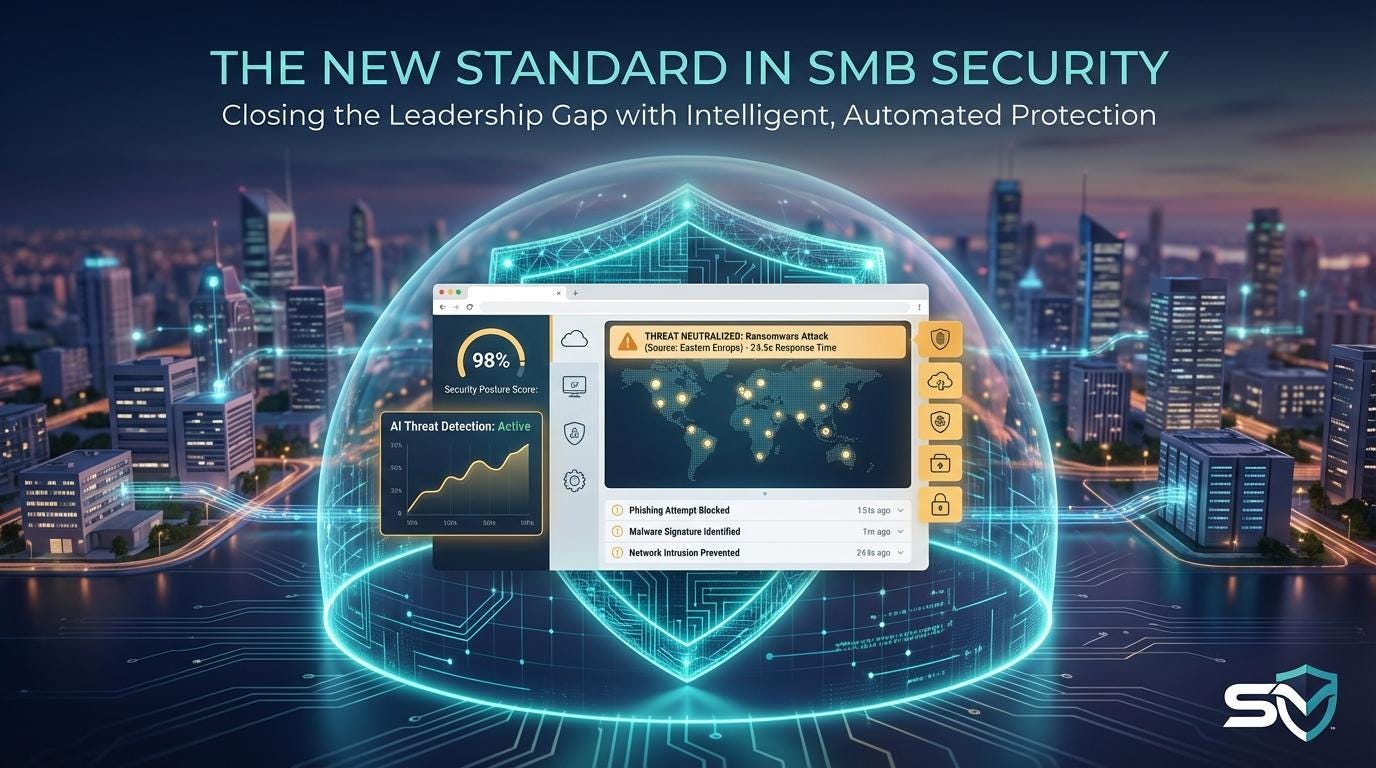
Here is a consolidated overview of the critical landscape and high-level strategic guidance, incorporating the essential baseline we’ve established:
The Modern Threat & Operational Reality
Attack Sophistication: Cybercriminals are now using AI-powered automated ransomware campaigns launched every 2 seconds, contributing to global costs projected to reach a staggering $74 billion this year. In 2025, 80 percent of small businesses faced a breach, with individual losses frequently exceeding $500,000. These are not just statistics; they are existential threats to business operations and reputations.
Browser as Perimeter: 95 percent of security incidents now begin in the web browser. The standard network perimeter is long gone; your browser is the perimeter. Legitimate business-centric activity, however essential, is increasingly risky and requires careful governance and control.
To manage the 'Browser Perimeter' effectively, tools like Sider AI integrate top-tier models directly into your workflow, allowing you to centralize web interactions into a secure, actionable knowledge base without toggling between high-risk tabs.
AI Risks & Opportunities: Beyond attack tools, leaders must be cautious about the risks posed by generic AI tools that may contain data bias or have ambiguous data retention policies, which can expose sensitive company data. Simultaneously, integrated AI-powered security tools are deemed necessary by over 62 percent of security leaders, and 73 percent plan to increase budgets for such platforms.
Strategic Mitigation: Active Resilience & Modern Frameworks
Active Resilience: This proactive posture moves beyond simple prevention to continuous monitoring of high-value assets and rapid incident containment. It recognizes that breaches will happen; the key is minimizing their impact and recovering quickly.
Framework Adoption: Frameworks like NIST CSF 2.0 provide a common, business-aligned language for risk, shifting the perception of security from a costly burden to a critical operational function. Prioritizing NIST principles ensures a structured, governance-driven approach.
Tactical Implementation: Immediate Action Points
For SMBs seeking immediate value, focus on narrow AI use cases and data-aware security while avoiding overly ambitious initial automation projects.
Implement a 90-Day “Active Resilience” Pilot:
Days 1–30: Conduct a comprehensive Asset Inventory (aligning with NIST CSF 2.0). Map every high-value data asset and user identity.
Days 31–60: Hardening phase. Deploy phishing-resistant MFA (FIDO2) across all applications, turn off vulnerable protocols like NTLM, block unauthorized browser extensions, and turn off “Save Password” features.
Move away from insecure, decentralized password management. Proton Pass for Business simplifies account security with end-to-end encryption and built-in 2FA, making it easy to enforce strong practices without adding complexity.
Days 61–90: Operationalize monitoring. Ingest logs from critical platforms (M365, Google Workspace) into AI-driven anomaly detection tools for real-time threat analysis.
Adopt Business-Specific Browsers: Deploy browsers with real-time AI to block phishing and prevent sensitive company data from being uploaded to public generative AI models. Utilize internal Data Loss Prevention (DLP) controls to intercept unauthorized “Paste” events and file uploads of source code or PII to non-approved AI domains.
Develop Core Actionable Checklists:
Credential Protection: Enforce phishing-resistant MFA and disable NTLM.
Browser Lockdown: Block unauthorized extensions and turn off saved passwords.
AI-Driven Email Defense: Implement DMARC/DKIM/SPF and look-alike detection.
Log Integrity: Ingest core system logs for AI anomaly detection.
Establish a Generative AI Acceptable Use Policy: Define approved models (prioritize Zero Data Retention), prohibited inputs (source code, PII), and mandatory human verification for outputs. Note: We provide a full policy template to our premium subscribers in the deep-dive section below.
Strategic Advice for SMB Cyber Leaders
Operationalizing the vCISO Model: Transition to a virtual CISO model to access expert leadership without the high cost of a full-time executive. The primary value of a vCISO is in strategic Risk-Based Prioritization—the critical decision of what not to fix, ensuring resources are concentrated on high-value, high-impact security initiatives.
Consolidation Alpha: Avoid “point solution bloat.” Favor integrated platforms to reduce the “integration tax”—the cost in time and complexity to make disparate tools work together. Keep your security team lean and focused by streamlining your technology stack.
Deepfake Defense: Enforce a mandatory, exception-free “Out-of-Band” verification protocol for any financial transaction over $5,000. For example, if an internal or external request seems high-stakes or comes from an unusual source, employees must call a pre-verified number to confirm legitimacy.
By focusing on these tactical, data-aware security practices and strategic leadership models, SMBs can effectively close the leadership gap, neutralize automated attacks, and build a resilient foundation for the challenges of 2026.
Get access to the additional content in “Section 2: Premium Intelligence - 2026 Deep Dives, Templates, and Exercises” for our paid subscribers.
Section 2: Premium Intelligence - 2026 Deep Dives, Templates, and Exercises
Welcome, premium subscribers, to this exclusive weekly briefing. While Section 1 provides the strategic baseline, this section is designed to give you the technical depth, tactical assets, and interactive exercises to translate strategy into action. This week, we’re expanding significantly on our core strategic themes.
1. Generative AI Acceptable Use Policy Template
Here is a comprehensive template based on the strategic objectives outlined above, designed to empower your team while protecting your critical data. Customize and implement this immediately.
Approved Models: Employees may only use AI platforms explicitly approved by the security team. We prioritize “Zero Data Retention” (ZDR) APIs or Enterprise versions that guarantee data will not be used to train public models.
Prohibited Public Tools: Use of “Consumer” versions of popular LLMs is strictly forbidden for business tasks. These often default to using prompts for training.
Shadow AI: Any new AI tool must undergo a “vCISO Review” before use.
Tactical Data Boundaries:
Prohibited Content: Never input Personally Identifiable Information (PII) of clients, internal source code, or unreleased financial statements. “If the data is not public knowledge, it does not belong in an LLM.”
Redaction Protocol: Before AI-summarizing meetings or analyzing reports, redact names, specific dollar amounts, and proprietary project titles. Use generic placeholders (e.g., “Client A,” “Project X”). Premium Insight: Implement automated DLP to enforce this for known sensitive data patterns.
Browser DLP: Our business-specific browsers are configured to automatically block “Paste” events of sensitive data into unauthorized AI domains.
Human Accountability & Output Verification:
Verification Mandatory: AI models can hallucinate. You must verify all factual claims, legal citations, and technical code generated by AI before sharing with a client or deploying to production.
Attestation: Any deliverable created with significant AI assistance should include an internal note or watermark for transparency and an audit trail.
Deepfake Awareness: Clearly label AI-generated audio or video as such to maintain trust and comply with 2026 standards.
2. Detailed Technical Takeaways & How-Tos
A. Decoding “Automated Opportunism”: The Threat Evolution
Technical Detail: Attackers are using sophisticated LLM-based scripts that automatically and randomly mutate ransomware signatures every few seconds. This makes signature-based AV/EDR almost completely ineffective.
Actionable Strategy: Implement Heuristic-based Endpoint Detection and Response (EDR) solutions immediately. These tools analyze behavioral anomalies (e.g., rapid file-encryption patterns, unusual process creation) rather than specific file hashes, enabling them to detect and block new variants of polymorphic malware in real time. Configure your EDR with tight, behavioral-based blocking policies, not just alert-only rules.
B. The Browser as Perimeter: Implementation Deep Dive
Browser Choice: Leverage business-specific browsers (many offer managed enterprise features/add-ons) that integrate AI-powered DLP and phishing protection directly into the browsing experience, independent of the underlying OS or network.
Configuration How-To:
MFA-Enforced Login: Require strong MFA for all managed browser logins.
Controlled Extension Marketplace: Allowlist approved extensions and block all unmanaged extensions to prevent data leakage and malicious add-ons.
DLP Rules: Configure granular rules within your managed browser console:
Clipboard Control: Prevent copying data from internal SaaS applications into unauthorized external sites.
File Upload Restriction: Explicitly block uploads containing patterns for specific file types (e.g., source code, PII spreadsheets) to unauthorized domains (including many public generative AI sites).
AI Domain Governance: Maintain a dynamically updated list of approved vs. blocked AI domains. Enable automated scanning of prompt inputs on all allowed AI domains for sensitive content.
C. Mitigating AI Data Bias & “Generic AI” Risks
Technical Takeaway: Generic LLMs, while powerful, are trained on massive, uncontrolled datasets, which inherently contain data bias. For specific internal tasks (e.g., log analysis, intelligent email filtering, vulnerability scoring), generic models can produce inaccurate results or even increase risk by reinforcing existing, undetected biases.
Actionable Strategy: Prioritize “Narrow AI” applications in which models can be fine-tuned to your organization’s unique traffic patterns, security events, and communication style. For example, use security-specialized AI modules from trusted vendors that have been trained on curated security datasets and then further fine-tuned using your local, anonymized logs and data. Avoid using generic public LLMs for automated decision-making or critical system monitoring without intensive human oversight and validation.
3. Implementation Templates, Samples & Checklists
A: Deepfake Defense Out-of-Band Verification Procedure
Sample SOP Snippet:
For all financial transactions over $5,000 initiated or approved via electronic communication (email, messenger, video call), the recipient/executor must immediately perform Out-of-Band verification. They must call a pre-verified phone number (from a centralized internal directory, not a number provided in the communication) for the individual or department associated with the request to confirm details verbally—absolutely no exceptions. Log the verification call and confirmation details with the transaction record.
B: Vendor AI Risk Assessment Questionnaire
Sample Questions Snippet:
Does your service integrate or utilize any third-party AI models? If so, identify them.
What are the origins, composition, and update frequency of your model training data?
What are your data retention policies for inputs (prompts) to the AI models? Are inputs used for training public models, even in an anonymized form? (Zero Data Retention Priority).
Do you have documented processes to identify and mitigate bias within your AI models?
Can you provide audit reports or certifications (e.g., SOC 2, ISO) that specifically address the security and privacy of the data processed by your AI integrations?
C: Technical “Active Resilience” 90-Day Pilot - Day 31-60 Hardening Checklist
[ ] Phishing-Resistant MFA (e.g., FIDO2) enforced for all employees on all SaaS/internal applications.
[ ] NTLM protocol disabled on all Domain Controllers and critical servers. Document and address any legacy application dependencies.
[ ] Managed browser policies implemented, allowing approved extensions only.
[ ] “Save Password” and form-fill features disabled in all managed browsers. Implement an enterprise password management solution instead.
[ ] Browser DLP rules deployed for PII and source code uploads to unauthorized AI domains.
[ ] DMARC/DKIM/SPF protocols configured and enforced for all outbound company email domains. DMARC policy set to “Reject” or “Quarantine” where appropriate.
[ ] AI-driven email defense system with look-alike domain detection enabled and configured to actively block or flag highly suspicious emails.
4. Strategic Exercises
Tabletop Exercise: Deepfake Financial Scam Scenario
Premise: A senior accountant receives a highly convincing deepfake video call (simulating the CEO or CFO) that urgently requests an out-of-band wire transfer to a new vendor for a critical project. The “executive” uses urgency, pressure, and specific details.
Exercise Goal: Test and refine the internal financial control and deepfake verification procedures. Did the accountant recognize the potential threat? Did they follow the strict Out-of-Band verification protocol? Were there any weaknesses or gaps identified (e.g., outdated contact lists, confusion about the procedure)? Use this exercise to reinforce training and improve procedural resilience.
Exercise: Evaluating Current CISO Leadership Model
Exercise Goal: Assess if a shift to a fractional vCISO model is appropriate. Consider: Do you have a full-time CISO with 2026-specific AI/cyber expertise? Are you effectively managing the leadership gap and strategically prioritizing risk? Analyze the costs and benefits of a high-quality vCISO engagement versus a less-experienced internal resource or no dedicated CISO leadership. Consider a potential strategic focus on decision optimization (risk-based prioritization) that a seasoned vCISO can provide.
5. Implementation Guides
vCISO Selection & Engagement SOW Checklist/Template Snippet
Scope of Work (SOW) Key Items:
Deliverables: Security Strategy Roadmap (annual update), Quarterly Risk Assessment & Board Reporting, Policy Development & Review (including Generative AI and Deepfake Defense), Incident Response Plan Management, Vendor AI Risk Assessment Support.
Meetings: Weekly strategy calls, monthly security updates, quarterly progress reviews.
Specific 2026 Focus: Explicit requirement for vCISO to demonstrate expertise in AI risks, browser security, social engineering defense, and NIST CSF 2.0.
Metrics for Success: Improved security posture scores (measured by specific tools or audits), reduced mean-time-to-containment for incidents, increased number of employees trained on new procedures, and successful completion of tabletop exercises.
Browser DLP Configuration Best Practices Guide
Detailed Guide Sections:
Step-by-step instructions for configuring DLP rules within popular managed browser consoles.
Specific examples of Regex patterns to use for identifying PII (Social Security Numbers, credit card numbers) and source code (common keywords/structures).
Recommendations for defining and dynamically managing approved AI tool lists vs. generic public models.
Guidance on continuous monitoring, rule refinement based on traffic patterns, and employee communication regarding browser DLP controls.
This comprehensive set of technical insights, detailed templates, strategic exercises, and implementation guides equips you, the premium subscriber, not only to understand the strategic vision but also to operationalize active resilience, mitigate sophisticated AI threats, and effectively bridge the leadership gap in 2026 and beyond.
Stay strategic, stay secure.
Tactical Implementation Roadmap
To move from theory to action, follow this 90-day pilot focused on hardening your most vulnerable vectors.
Phase 1: The 90-Day Pilot
Days 1–30 (Asset Inventory): Map every high-value data asset and user identity. You cannot protect what you don’t know exists.
Days 31–60 (Hardening): Deploy phishing-resistant MFA (like FIDO2 keys) and disable NTLM to prevent credential relay attacks. Lock down browsers by blocking unauthorized extensions and turning off “Save Password” features.
Days 61–90 (Automated Monitoring): Ingest Google Workspace or M365 logs into an AI-driven anomaly detection tool to catch identity theft in real-time.
Phase 2: Defense-in-Depth Checklist
Email Defense: Enforce DMARC/DKIM/SPF protocols and utilize AI-driven “look-alike” domain detection.
Deepfake Protocols: Establish a mandatory “Out-of-Band” verification for any financial transaction over $5,000. If an “Executive” sends a message, the recipient must call a pre-verified number to confirm—no exceptions.
AI Policy: Create a clear Acceptable Use Policy that limits generative AI use to “Zero Data Retention” models only, ensuring your company secrets don’t end up in a public training set.
Policy Objective: Empowering Innovation While Neutralizing Risk
The primary goal of this Generative AI Acceptable Use Policy is to enable our team to leverage AI productivity gains without compromising company intellectual property or client confidentiality. By focusing on “Zero Data Retention” models and strict data boundaries, we ensure our competitive advantage remains internal. This policy moves us toward an active state of resilience in which technology serves the business safely.
Pillar 1: Strategic Tool Selection and “Zero Data Retention”
We prioritize tools that provide enterprise-grade privacy protections to prevent our data from being used to train public models.
Approved Models: Employees may only use AI platforms explicitly approved by the security team. We favor “Zero Data Retention” (ZDR) APIs or Enterprise versions of tools where the provider contractually agrees not to store or learn from our inputs.
Prohibited Public Tools: Use of “Consumer” versions of popular LLMs is strictly forbidden for business tasks. These public versions often default to using your prompts for training, which could expose our private strategies to competitors.
Shadow AI: Any new AI tool not currently on the approved list must undergo a 48-hour “vCISO Review” to ensure its data privacy policy aligns with our risk appetite.
Pillar 2: Tactical Data Boundaries and Input Restrictions
The most significant risk in AI adoption is the “leaking” of sensitive data through the prompt window. We maintain a “No PII, No Secrets” rule for all AI interactions to mitigate this.
Prohibited Content: You are never permitted to input Personally Identifiable Information (PII) of clients, internal source code, or unreleased financial statements into an AI tool. If the data is not public knowledge, it does not belong in an LLM.
Redaction Protocol: Before using AI to summarize a meeting or analyze a report, you must scrub all names, specific dollar amounts, and proprietary project titles. Use generic placeholders like “Client A” or “Project X” instead.
Browser DLP: Our business-specific browsers automatically block “Paste” events that contain recognized patterns of sensitive data to unauthorized AI domains.
Pillar 3: Human Accountability and Output Verification
While AI can generate content rapidly, the legal and ethical responsibility for that content remains with the human employee. We enforce a “Human-in-the-Loop” requirement for all AI-assisted work.
Verification Mandatory: AI models can “hallucinate” or provide biased information. You must verify all factual claims, legal citations, and technical code generated by an AI before it is shared with a client or deployed to production.
Attestation: Any major deliverable created with significant AI assistance should include a small internal note or watermark. This transparency ensures we can track the origin of the logic if a bias or error is discovered later.
Deepfake Awareness: If an AI tool is used to generate audio or video for marketing, it must be clearly labeled as “AI-Generated” to maintain trust with our audience and comply with 2026 transparency standards.
Help Other Leaders Secure Their Future
The Network Effect of SMB Security
The most effective way to strengthen our SMB community is by sharing the strategies that actually work in the field. If you find value in these technical deep dives, helping a fellow leader bridge their tech gap makes the entire ecosystem more resilient. Cybersecurity is a collective effort and more informed peers lead to a safer environment for everyone’s business.
Why Share This Subscription? When you refer a colleague to this newsletter, you are giving them access to the same specialized insights you use to lead your team:
Zero-fluff technical execution: No high-level theory, just the steps to implement.
Cost-saving vendor analysis: Honest looks at which tools are worth the SMB budget.
Direct coaching frameworks: Access to the same logic I use with private coaching clients.
Pay It Forward Use the button below to share this post or your unique referral link. When your peers join our community, we all benefit from a more secure and tech-forward marketplace.


