
This Week's SMB Risk Signals: A VPN Zero-Day, an AI Pricing Fight, and Siri's Workflow Creep
What SMB leaders should do this week about remote-access risk, AI pricing governance, and Apple’s workflow AI push.

This week delivered a clean reminder that SMB risk does not arrive in neat categories. On June 8, 2026, Check Point disclosed active exploitation of a critical VPN authentication bypass tied to real-world ransomware activity. On June 9, 2026, Colorado’s governor vetoed an AI and data pricing bill that would have put guardrails around how technology influences prices and wages. And at WWDC26, Apple showed just how quickly AI is moving from optional tool to built-in workflow layer for email, documents, images, passwords, and day-to-day assistant use.
For SMB leaders, the strategic point is straightforward: the attack surface is expanding faster than policy, and policy is evolving slower than employee behavior. You cannot wait for one perfect regulation, one perfect tool, or one perfect quarter to act. You need tighter operating discipline now.
1. Your Remote Access Layer Is Still a Breach Path
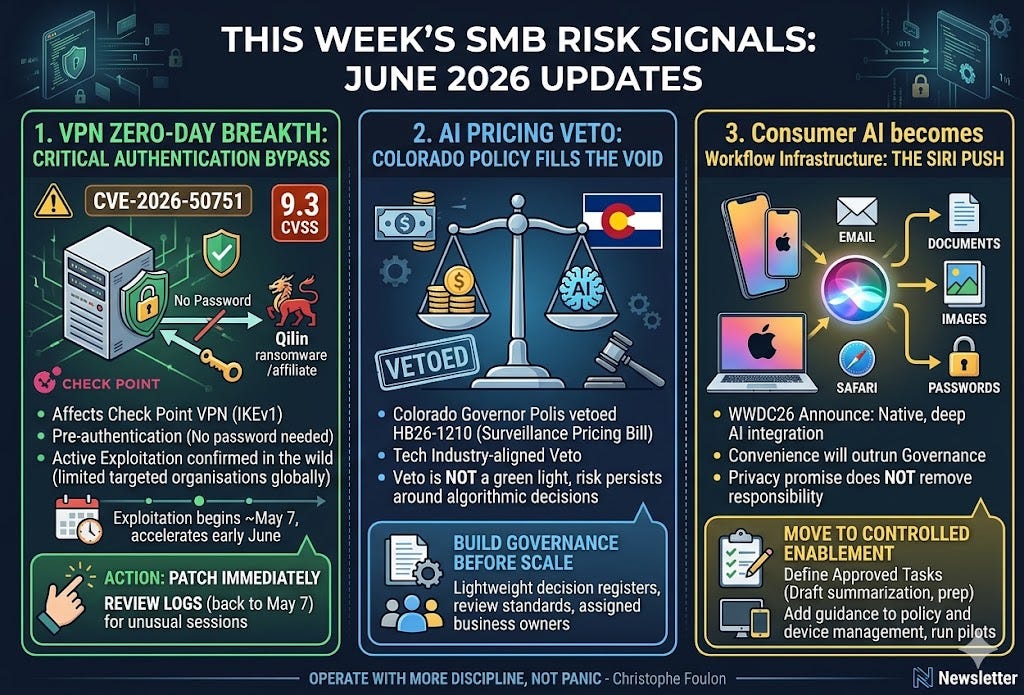
On June 8, 2026, Check Point disclosed active exploitation of CVE-2026-50751, a critical 9.3 CVSS authentication bypass affecting Remote Access VPN and Mobile Access deployments configured to use the deprecated IKEv1 protocol. Check Point said the activity had already hit a few dozen organizations globally, with one confirmed case tied to a Qilin ransomware affiliate. Check Point’s own timeline says exploitation began on May 7 and accelerated in early June.
Why You Should Be Concerned:
The flaw is pre-authentication: Attackers do not need a valid user password to establish a VPN session if the affected configuration is in place.
The ransomware path is already visible: This is not theoretical. Check Point tied at least one post-compromise case to a Qilin affiliate.
The SMB version of this problem is common: Smaller firms often keep older remote-access configurations in place because they are “still working,” especially when a single appliance, MSP, or internal admin owns the entire edge.
Strategic Action: Treat remote access as a business continuity issue, not a firewall setting. If your edge is old, poorly documented, or managed by habit, assume it deserves executive review this week.
Three steps to take this week:
Confirm whether any Check Point Remote Access VPN or Mobile Access deployments still rely on IKEv1, then apply the June 8 security update immediately where relevant.
Review VPN and identity logs going back to May 7, 2026 for unusual remote-access sessions, especially sessions that do not line up cleanly with valid user behavior.
Re-rank remote access, privileged access, and endpoint isolation in your incident-response priorities before the next executive operations meeting.
If you are tightening the edge and want stronger containment when endpoints are exposed, Bitdefender is a practical fit for SMB teams that need stronger endpoint protection and response coverage without building a large in-house security operation.
2. The Rules for AI-Driven Pricing and Pay Are Still Moving
On June 9, 2026, Colorado Gov. Jared Polis vetoed a bill that would have limited the use of artificial intelligence and other data to set consumer prices and employee wages. Axios reported that Polis rejected 12 bills in total and sided with the tech industry in at least five vetoes, arguing this bill was too broad and could capture innocuous technology uses.
Why You Should Be Concerned:
A veto is not a green light: The absence of one law does not mean the underlying risk has disappeared. It means the policy fight is still active.
Pricing and workforce decisions are already data-driven: CRM tools, finance tools, POS platforms, scheduling software, and AI copilots can all shape outcomes long before leadership labels them as “AI systems.”
Your documentation gap is probably wider than your tech gap: Many SMBs can describe the tool they bought, but not the decision it influences, the data it uses, or the human override that exists when the output looks wrong.
Strategic Action: Build governance before you build scale. I recognize that for many SMBs, lean teams and limited budget make this feel like another policy burden. In practice, a lightweight decision register and review standard are much cheaper than defending an opaque pricing or wage process later.
Three steps to take this week:
Inventory every workflow where software or AI influences pricing, quoting, discounting, compensation, scheduling, or performance scoring.
Assign a named business owner to each workflow and document the human review point, the source data, and the business objective.
Flag any workflow that touches protected classes, employment decisions, or customer segmentation for counsel or compliance review before it expands.
DO NOT WAIT FOR THE PERFECT LAW TO TELL YOU WHAT GOOD GOVERNANCE LOOKS LIKE.
If you need to prove that controls, evidence collection, and review steps actually exist, operational discipline matters more than policy theater.
Copla helps growing companies automate evidence collection and continuous compliance work while keeping expert support in the loop.
Reduce manual governance drag. Review Copla here
3. Consumer AI Is Becoming Workflow Infrastructure
Apple used WWDC26 to show that AI is moving directly into everyday work surfaces. In Apple’s official WWDC26 materials, the company positioned Siri AI in iOS 27 as able to edit and write emails, texts, and documents; create photorealistic images; organize Safari activity; and update compromised passwords with one tap, while emphasizing privacy protections for personal information.
Why You Should Be Concerned:
This is built into routine work, not a side app: Email, text, documents, images, browser activity, and password hygiene all sit inside normal employee behavior.
Convenience will outrun governance: Staff will adopt embedded AI features because they save time, not because your policy allows it.
The privacy promise does not remove your responsibility: Even when a platform markets itself as private, you still need clear rules on what staff can paste, summarize, generate, and share.
Strategic Action: Move from blanket bans or blind enthusiasm to controlled enablement. Your job is not to stop every assistant. Your job is to decide which jobs are safe, which data classes are off-limits, and which outputs require human review.
Three steps to take this week:
Define three approved AI-assisted tasks for your team, such as draft summarization, internal meeting prep, or first-pass writing, and three prohibited tasks, such as handling regulated personal data or final external commitments without review.
Add AI-use guidance to device management, acceptable-use policy, and manager coaching, especially for sales, HR, finance, and client-facing staff.
Run a two-week pilot with a short after-action review so you learn where productivity improves and where risk starts to leak.
Final Thoughts for Leaders
The convergence of remote-access weakness, unfinished AI regulation, and built-in assistant workflows means SMB leadership has to operate with more discipline, not more panic. The real question is not whether these technologies are coming. It is whether your operating model is mature enough to absorb them without turning speed into unmanaged exposure. Put remote access, automated decision governance, and approved AI use on your next leadership agenda before the end of this week.
Help Other Leaders Secure Their Future
The Network Effect of SMB Security
The most effective way to strengthen our SMB community is by sharing the strategies that actually work in the field. If you find value in these technical deep dives, helping a fellow leader bridge their tech gap makes the entire ecosystem more resilient. Cybersecurity is a collective effort and more informed peers lead to a safer environment for everyone’s business.
Why Share This Subscription? When you refer a colleague to this newsletter, you are giving them access to the same specialized insights you use to lead your team:
Zero-fluff technical execution: No high-level theory, just the steps to implement.
Cost-saving vendor analysis: Honest looks at which tools are worth the SMB budget.
Direct coaching frameworks: Access to the same logic I use with private coaching clients.
Pay It Forward Use the button below to share this post or your unique referral link. When your peers join our community, we all benefit from a more secure and tech-forward marketplace.
You’ve seen the "Why" behind this, but knowing the risk is only half the battle. To move from awareness to actual protection, you need a localized execution plan.
The remainder of this deep dive is designed specifically for the SMB leader who needs to move fast without a massive enterprise budget. By upgrading to a paid subscription, you unlock:
The “How-To” Framework: A step-by-step breakdown of the [Process/Tool] mentioned above.
Resource Toolkit: Downloadable templates and checklists I use with my private coaching clients.
The Bottom Line: Direct analysis of the ROI and cost-savings associated with this strategy
Subscribe to Unlock the Full Strategy
Join a community of SMB leaders who stop reacting to tech shifts and start leading them.
