
This Week's SMB Risk Signals: Control Planes, AI Oversight, and the Tools That Can Act for You
Control-plane risk is now the SMB leadership problem.

On July 1, 2026, CISA added a Microsoft SharePoint Server deserialization vulnerability to its Known Exploited Vulnerabilities catalog, with a July 4 remediation due date for federal agencies. Two days earlier, CISA added a SimpleHelp authentication-bypass vulnerability, also with a compressed remediation window. The same recent KEV cluster included enterprise communication, engineering, remote administration, and network-management products from Cisco, PTC, Lantronix, and Ubiquiti. Separately, Colorado’s revised AI law has shifted the compliance conversation toward automated decision-making technology used in consequential decisions, while Anthropic’s June 30 announcements pushed more agentic and auditable AI work into everyday business lanes.
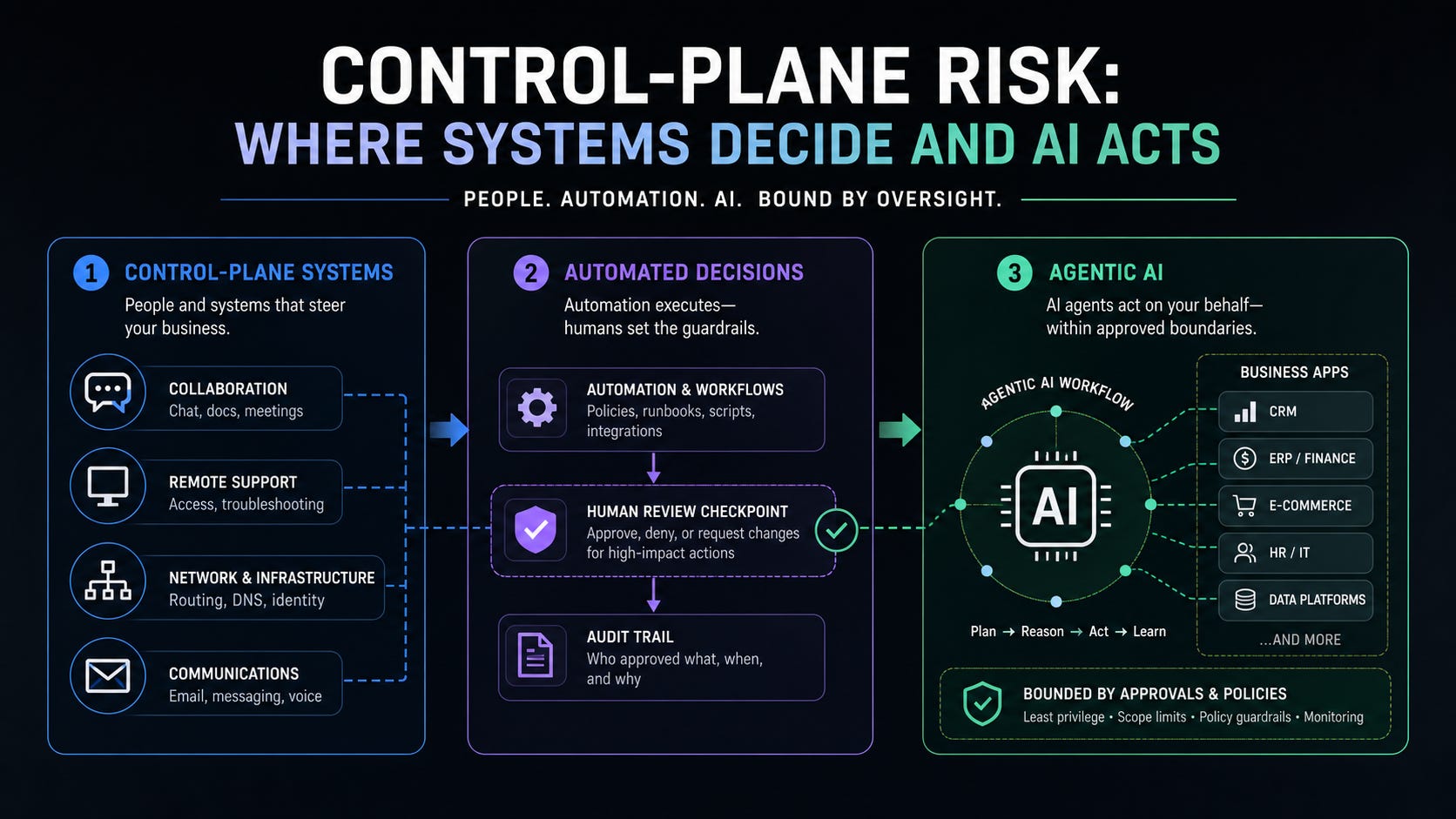
The common thread this week is not a single malware family or vendor. It is control. Attackers are targeting the systems that coordinate work, provide remote help, route communications, manage devices, and store collaboration data. Regulators are asking whether automated decisions can be explained, corrected, and reviewed. AI vendors are making it easier for software to perform more of the work itself. For SMB leaders, the question is no longer whether a tool is useful. It is whether the tool has authority over your business that you can see, limit, and reverse.
1. Collaboration and Remote-Support Tools Are Now Front-Door Risk
CISA’s most recent KEV additions are a useful leadership signal because they are not clustered in a single obscure product category. SharePoint is a collaboration backbone. SimpleHelp is remote support. Cisco Unified Communications Manager supports voice and collaboration. PTC Windchill and FlexPLM can sit close to product, engineering, and lifecycle operations. Ubiquiti UniFi OS and Lantronix EDS5000 touch network and device administration.
That matters because these platforms often sit above ordinary endpoint risk. They connect people, vendors, admins, files, devices, and workflows. If an attacker gets leverage there, the blast radius is not just one laptop. It can serve as a route into documents, privileged access, helpdesk workflows, engineering data, customer records, or operational systems.
The exploit window is shrinking: CISA’s recent federal due dates are measured in days, not weeks. Even if those due dates formally apply to federal agencies, they are a practical signal for every organization that depends on the same products.
Remote support needs more scrutiny than ordinary SaaS: A remote-support product is supposed to cross trust boundaries. That makes authentication bypass and session-control weaknesses especially sensitive.
Collaboration systems are evidence systems: SharePoint, communications tools, and product systems hold records your team may need during an incident, audit, dispute, or insurance claim.
Strategic Action: Treat collaboration, remote support, communications, and network management platforms as control-plane systems. They deserve shorter patch timelines, tighter admin review, and separate incident playbooks.
Partner resource: For the 72-hour exposure review, Tenable is a practical fit for teams that need vulnerability and exposure visibility across internet-facing systems, remote-support tooling, and infrastructure.
Tenable is an affiliate link, which means CPF Coaching may earn a commission if you choose to use it.
This Week’s Leadership Move:
Ask your IT owner or managed provider for a list of products that can administer devices, provide remote support, manage network gear, store regulated data, or coordinate internal files.
Check whether any product in that list appears in CISA KEV or vendor emergency advisories.
Create a 72-hour rule for exploited vulnerabilities in those systems, even if your normal patch cycle is monthly.
2. AI Compliance Is Moving From Model Labels to Decision Rights
Colorado’s revised AI law is useful for SMB leaders because it moves the discussion away from abstract AI hype and toward a practical question: when automated decision-making technology materially influences a consequential decision, what does the business owe the person affected?
The revised law uses an automated-decision framework rather than simply asking whether a tool is branded as “AI.” Norton Rose Fulbright’s analysis notes that the revised Colorado framework focuses on covered automated decision-making technology used in consequential decisions, including employment, housing, financial services, insurance, health care, education, and government services. It also emphasizes notice, explanation, correction, and meaningful human review after adverse outcomes.
That structure should catch the attention of SMBs even outside Colorado. Many smaller firms use applicant-screening tools, lead-scoring systems, customer-risk flags, insurance workflows, credit tools, clinical intake products, scheduling engines, or automated customer support triage without calling them AI governance issues. The label matters less than the decision's impact.
Inventory beats policy theater: A generic AI policy does not help if nobody knows where automated recommendations influence customers, employees, tenants, patients, borrowers, or applicants.
Human review has to be operational: It is not enough to say a person is “in the loop” if the reviewer cannot see the inputs, correct bad data, override the decision, or explain the outcome.
Vendor documentation is now part of your evidence trail: If a third-party system influences a consequential decision, your contract, configuration, logs, and escalation path matter.
Strategic Action: Build an automated-decision register before you buy another AI or analytics tool. List where software scores, ranks, recommends, blocks, approves, escalates, or materially influences decisions about people.
Partner resource: If the automated-decision register turns into a compliance evidence project, Copla can help SMBs organize cyber risk, assessments, and compliance workflows without building an enterprise GRC stack.
Copla is an affiliate link, which means CPF Coaching may earn a commission if you choose to use it.
This Week’s Leadership Move:
Pick one department, such as HR, sales, finance, health operations, or customer success.
Identify every workflow where software recommends or influences a decision about a person.
For each workflow, document the owner, vendor, data source, appeal path, human reviewer, and override authority.
3. Agentic AI Is Becoming an Operating Model, Not a Side Experiment
Anthropic’s June 30 release notes point in the same direction as the broader AI market: more agentic everyday work, more specialized AI applications, and more emphasis on auditable artifacts. Anthropic described Sonnet 5 as its most agentic Sonnet model for coding and everyday professional work, and described Claude Science as a customizable app that integrates common research tools, produces auditable artifacts, and provides flexible compute access.
For SMBs, the specific vendor matters less than the operating pattern. AI tools are moving from “write a draft” toward “use tools, work across systems, produce artifacts, and act inside business workflows.” That can be valuable. It can also create a silent risk when AI can access customer data, privileged systems, regulated decisions, code, financial workflows, or external communications.
Auditable artifacts are becoming a buying criterion: If an AI system performs meaningful work, your team needs evidence of inputs, outputs, tools used, approvals, and final changes.
Agentic work needs budget and authority limits: A model that can browse, code, schedule, file, summarize, or update records can create operational cost and operational exposure.
Specialized AI apps can bypass central review: A research, coding, sales, or support tool may enter through one team while raising enterprise-wide data and security questions.
Strategic Action: Do not approve agentic AI by demo quality alone. Approve it through workflow, authority, data boundaries, logging, rollback, and the business owner.
Partner resource: For leaders experimenting with agentic AI, Airia is worth evaluating when the requirement is governed AI workflow execution, not just another chat window.
Airia is an affiliate link, which means CPF Coaching may earn a commission if you choose to use it.
This Week’s Leadership Move:
Select one current or proposed AI workflow and classify it as advisory only, draft-and-review, or permissioned execution.
Write the stop condition: when must the workflow pause and ask a human?
Confirm where logs, prompts, tool actions, files, and final outputs are retained.
Final Thoughts for Leaders
This week is about the systems that sit above the work. SharePoint, remote support, communications systems, network management, automated decisions, and agentic AI all carry a common risk: they can coordinate action faster than leadership can inspect it. That is the control-plane problem.
You do not need a giant security program to respond. You need a shorter list of critical systems, faster action on actively exploited vulnerabilities, an automated-decision register, and clear rules for where AI can advise, draft, or act. Put those four items on the leadership agenda before the holiday week ends.
Help Other Leaders Secure Their Future
The Network Effect of SMB Security
The most effective way to strengthen our SMB community is to share strategies that actually work in the field. If you find value in these technical deep dives, helping a fellow leader bridge their tech gap makes the entire ecosystem more resilient. Cybersecurity is a collective effort, and more informed peers lead to a safer environment for everyone’s business.
Why Share This Subscription? When you refer a colleague to this newsletter, you are giving them access to the same specialized insights you use to lead your team:
Zero-fluff technical execution: No high-level theory, just the steps to implement.
Cost-saving vendor analysis: An honest look at which tools are worth the cost for SMB budgets.
Direct coaching frameworks: Access to the same logic I use with private coaching clients.
Pay It Forward. Use the button below to share this post or your unique referral link. When your peers join our community, we all benefit from a more secure and tech-forward marketplace.
You’ve seen the "Why" behind this [Cyber/Tech Issue]—but knowing the risk is only half the battle. To move from awareness to actual protection, you need a localized execution plan.
The remainder of this deep dive is designed specifically for the SMB leader who needs to move fast without a massive enterprise budget. By upgrading to a paid subscription, you unlock:
The “How-To” Framework: A step-by-step breakdown of the [Process/Tool] mentioned above.
Resource Toolkit: Downloadable templates and checklists I use with my private coaching clients.
The Bottom Line: Direct analysis of the ROI and cost-savings associated with this strategy
Subscribe to Unlock the Full Strategy
Join a community of SMB leaders who stop reacting to tech shifts and start leading them.
Premium Intelligence: The SMB Control-Plane Risk Pack
1. 72-Hour Control-Plane Exposure Review
Technical Detail: CISA’s recent KEV additions included Microsoft SharePoint Server, SimpleHelp, Cisco Unified Communications Manager, PTC Windchill and FlexPLM, Lantronix EDS5000, and Ubiquiti UniFi OS. The product mix matters because it spans the collaboration, remote support, communications, product lifecycle, network, and device management layers.
Use this review for any system that can administer devices, provide remote access, store collaboration records, manage network infrastructure, route business communications, or coordinate product data.
Control Questions:
Who owns emergency patch approval for this system?
Who can create, elevate, or disable admin access?
What vendor or MSP accounts can access it?
Where are admin actions logged?
What business process fails if the system is taken offline?
What customer, employee, or regulated data can be reached through it?
72-Hour Actions:
Search the product name in CISA KEV and the vendor’s security advisories.
Confirm version, patch status, and internet exposure.
Review admin, service, and vendor accounts.
Export or preserve audit logs before making major changes.
Confirm backup and recovery path for configuration and records.
2. Automated-Decision Register for Lean Teams
Technical Detail: The revised Colorado AI framework focuses on automated decision-making technology that materially influences consequential decisions. The practical issue for SMBs is not whether a tool markets itself as AI. It is whether software influences decisions about employment, financial access, insurance, health care, housing, education, government services, or similarly sensitive outcomes.
Start with a simple register. Do not overbuild it.
Workflow Tool or vendor Decision affected Data used Human reviewer Override path Evidence retained Candidate screening Interview selection Resume, assessments Customer risk scoring Approval or escalation CRM, payment history Support prioritization Response urgency Ticket text, account tier Credit, billing, or access decision Service access Financial or usage data
Minimum Evidence Standard:
Tool owner
Vendor contract or terms
Data fields used
Decision category
Human review owner
Correction path
Logs retained
Customer or employee notice, where applicable
3. Agentic AI Authorization Map
Use this map before letting AI tools act inside live systems.
AI workflow Allowed to advise Allowed to draft Allowed to act Data boundary Approval owner Logs retained Stop condition Draft customer response Yes Yes No Customer ticket only Support lead Ticket + AI log Legal, refund, threat, regulated claim Update CRM records Yes Yes Conditional CRM fields approved Sales ops CRM history + AI log Missing source or confidence flag Write or modify code Yes Yes Conditional Repo scope only Engineering owner PR + test output Security-sensitive change Vendor-risk review Yes Yes No Contract and questionnaire only Operations owner Review memo Missing evidence
Operating Rule: AI may move faster than your team, but it should not outrun ownership. Every permissioned workflow needs a named owner, explicit data boundary, retained logs, and a rollback path.
Premium Template: Friday Control-Plane Briefing
Use this in a 30-minute leadership meeting.
Part 1: Critical Systems
Which collaboration, remote-support, communications, network, and admin tools are business critical?
Which have internet exposure?
Which have privileged vendor or MSP access?
Which appeared in KEV or vendor emergency advisories in the last 30 days?
Part 2: Automated Decisions
Where does software score, rank, approve, deny, escalate, or recommend actions affecting people?
Which decisions have a human review path?
Which decisions can be explained and corrected?
Part 3: Agentic AI
Which AI workflows can act in live systems?
Which can only draft?
Which are advisory only?
Where are logs and outputs retained?
What is the stop condition for each workflow?
Premium Checklist: 10-Day Control-Plane Sprint
[ ] Inventory collaboration, remote support, communications, network management, and admin tools.
[ ] Check the inventory against CISA KEV and vendor advisories.
[ ] Assign a 72-hour patch owner for exploited vulnerabilities in control-plane systems.
[ ] Review admin and vendor access for remote-support and collaboration platforms.
[ ] Confirm logs are retained for admin actions and remote sessions.
[ ] Create an automated-decision register for one department.
[ ] Document human review and override paths for sensitive automated decisions.
[ ] Classify AI workflows into advisory, draft-and-review, and permissioned-execution lanes.
[ ] Write stop conditions for the top three AI workflows.
[ ] Preserve evidence: patch receipts, access reviews, decision register, AI logs, and approval notes.
Sources
CISA, Known Exploited Vulnerabilities Catalog JSON feed, accessed July 3, 2026: https://www.cisa.gov/sites/default/files/feeds/known_exploited_vulnerabilities.json
CISA, Known Exploited Vulnerabilities Catalog: https://www.cisa.gov/known-exploited-vulnerabilities-catalog
Norton Rose Fulbright, “Colorado enacts revised AI law,” May 2026: https://www.nortonrosefulbright.com/en-us/knowledge/publications/18733d31/colorado-enacts-revised-ai-law
Anthropic, homepage release listings for “Introducing Sonnet 5” and “Announcing Claude Science,” accessed July 3, 2026: https://www.anthropic.com/
The White House, “Promoting Advanced Artificial Intelligence Innovation and Security,” June 2, 2026: https://www.whitehouse.gov/presidential-actions/2026/06/promoting-advanced-artificial-intelligence-innovation-and-security/