
This Week's SMB Risk Signals: Identity Trust, Retail Privacy, and AI Hardening
The systems enforcing your rules now need the hardest scrutiny.

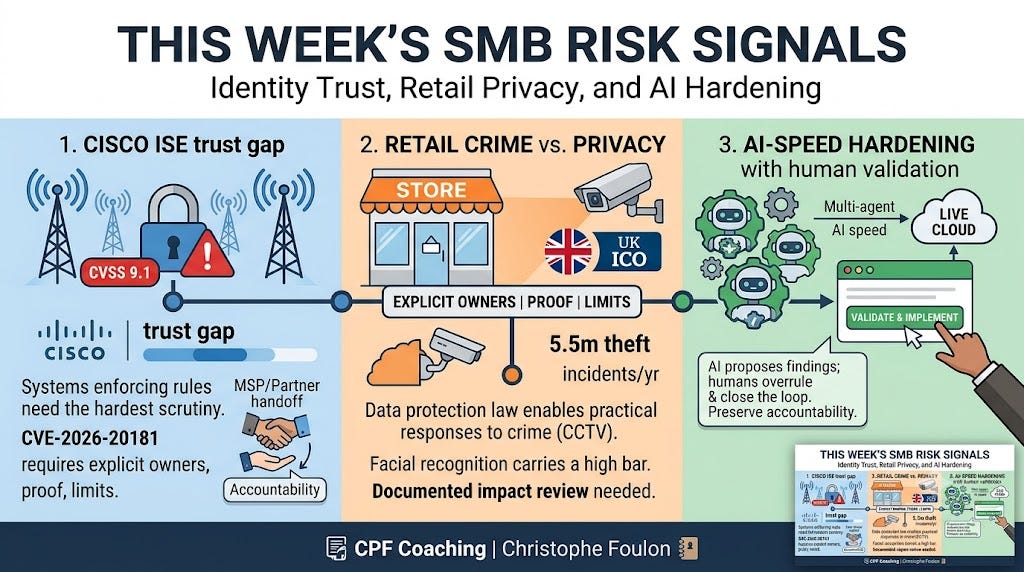
On July 6, 2026, Cisco updated its advisory for Cisco Identity Services Engine and Cisco ISE Passive Identity Connector to include two tracked issues, including CVE-2026-20181, a CVSS 9.1 remote code execution vulnerability, and noted that no workarounds are available. On July 3, 2026, the UK Information Commissioner's Office told small retailers that data protection law still allows them to use personal information, including CCTV footage, to protect staff and premises, while warning that facial recognition carries a high bar due to the risk of wrongful identification. On July 8, 2026, Microsoft said its Secure Future Initiative now uses a multi-agent AI system to evaluate live cloud services at AI speed, but still routes findings through human security engineers for validation and implementation.
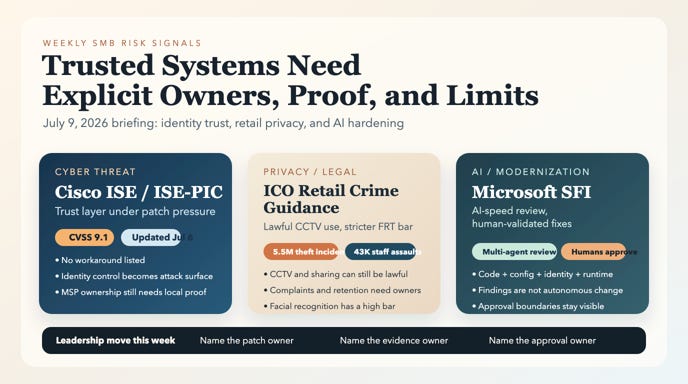
These are three versions of the same leadership problem. The systems you trust to enforce access, protect property, and accelerate operations are now high-trust systems in their own right. For SMB leaders, the question is no longer whether these tools are useful. It is whether you can prove who owns them, how quickly they must be patched, what data they can touch, and where a human must still overrule them.
1. The Tools Deciding Access Can Become the Attack Surface
Cisco ISE and ISE-PIC are not ordinary apps. They sit close to identity, policy, and network-admission decisions. That is what makes Cisco's July 6 update important. If the platform making access decisions is itself under urgent patch pressure, the leadership risk is not just a server issue. It is a trust issue at the layer that governs who and what gets onto your environment.
Critical severity changes the conversation: Cisco's advisory lists CVE-2026-20181 and CVE-2026-20190, assigns the package a CVSS score of 9.1, and directs customers to software updates rather than workarounds.
Identity infrastructure is a force multiplier: A weakness in ISE or ISE-PIC can put a control system at risk, not just an endpoint, meaning the operational blast radius can be broader than the asset count suggests.
Managed environments are still your accountability problem: Many SMBs do not run these systems directly. A partner, MSP, or network integrator may own the day-to-day work, but your business still owns the exposure and the evidence trail.
Strategic Action: Treat identity and network-admission platforms as crown-jewel control systems. They deserve named patch owners, shorter review windows, preserved logs, and explicit rollback plans.
This Week's Leadership Move:
Confirm whether your organization or any managed provider runs Cisco ISE or ISE-PIC in any environment.
Ask for the current version, the fixed-release path, and the maintenance window that has already been assigned to the update.
Preserve admin and policy-change logs before patching, and confirm who has authority to disable or limit access if a patch slips.
To reduce the odds that an infrastructure weakness turns into a business-wide blind spot, Tenable helps teams see exposed assets, prioritize urgent weaknesses, and pressure-test where trusted systems still need faster remediation.
Affiliate sponsor
2. Privacy Law Does Not Block Crime Response, but It Does Demand Discipline
The ICO's July 3 guidance matters because it corrects a common SMB mistake from both directions. Some leaders assume privacy law blocks practical responses to crime. Others assume that if theft is rising, any surveillance step is justified. The ICO said neither instinct is strong enough on its own.
The operational pressure is real: The ICO cited British Retail Consortium figures of almost 5.5 million incidents of theft and 43,000 incidents of violence against staff every year across the retail sector.
Lawful use is still available: The regulator explicitly said data protection law enables businesses to use personal information, including CCTV footage, to protect the business, its staff, and its premises.
Facial recognition is a separate decision: The ICO said there is a high bar for lawful use of facial recognition in public places because of the sensitivity of the data and the risk of misidentifying someone.
Strategic Action: Do not treat privacy as a blocker or a blank check. Treat it as an operating constraint that must be designed into your crime-response workflow before the next incident lands.
This Week's Leadership Move:
Write down what information your team captures, shares, and retains when theft, violence, or repeat-shopper incidents occur.
Confirm who can access CCTV, who can share clips or names, how long records are retained, and where complaints are routed.
Keep facial recognition out of production until you have a written justification, a documented impact review, and a named approval authority.
DON'T CONFUSE URGENCY WITH LEGAL COVERAGE
Small businesses still need evidence, retention logic, and complaint handling when they respond to crime. If your response process depends on ad hoc judgment, your team will be improvising under pressure.
Copla helps teams turn policy ownership, evidence collection, and control reviews into something repeatable instead of something remembered only after an incident.
Make compliance operational. See Copla
Affiliate sponsor
3. AI-Speed Hardening Still Requires Human Owners
Microsoft's July 8 post is useful because it does not present AI as a magical replacement for security engineering. It presents AI as a way to evaluate live services faster, with more context, and at a scale humans struggle to maintain alone. The key detail is what Microsoft kept human.
The architecture is multi-agent, not single-shot: Microsoft described a multi-agent system that evaluates cloud services against Secure Future Initiative requirements.
The context is broader than code scanning: The system combines code-level vulnerabilities with configuration, identity, network, and runtime context to assess overall service posture.
Human validation still closes the loop: Microsoft said the system generates findings and recommendations that security engineering teams then validate and implement.
Strategic Action: If your SMB wants AI in security or IT operations, use it first to compress review time and surface evidence faster. Do not let it close findings, change policy, or touch production systems without named human approval.
This Week's Leadership Move:
Select one review workflow in which AI can propose findings but cannot mark the issue as complete.
Log what evidence the AI reviewed, who approved the recommendation, and what changed afterward.
Expand only after you can measure both the time saved and the quality tradeoffs.
Final Thoughts for Leaders
Trusted systems deserve harder scrutiny, not easier trust. Identity engines, retail-surveillance workflows, and AI-assisted hardening all sit close to action. That means your next step is not to buy more dashboards. It is to name a patch owner, an evidence owner, and an approval owner for every system that can materially change access, rights, or operations.
If you put only one thing on next week's agenda, make it this: which systems in this business can act with trust we have not recently re-earned?
NEW CPF FRAMEWORK: THE ACTIVE RESILIENCE METHOD
This is the operating model behind CPF Coaching going forward: Assess, Reinforce, Monitor. Assess where compliance pressure is already creating risk. Reinforce the controls, owners, and evidence that need to hold under pressure. Monitor the systems, vendors, and AI-assisted workflows that can drift quietly after the meeting ends.
CPF Coaching helps 50-500 person healthtech, fintech, and SaaS companies turn compliance pressure into active resilience, without the full-time CISO price tag.
If another operator or business owner on your team needs this framing, use the share and referral tools below before the premium section.
If you want the implementation pack, templates, and tabletop below, the subscribe prompt is the quickest way to access the premium section.
Paid subscribers this week get a trusted-systems owner register, a retail-crime privacy checklist, an AI hardening approval matrix, and a seven-day implementation sprint.
FOR CONSULTANTS, MSPS, AND FRACTIONAL SECURITY LEADERS
I also published the first ARM-branded Base44 template preview: an ARM Client Portal Template for intake, evidence tracking, control reviews, AI-assisted framework guidance, and client-ready dashboards.
Use it as a starting point if you need a repeatable way to help SMB clients move through Assess, Reinforce, and Monitor without rebuilding the workflow every time.
Preview the template: ARM Client Portal Template for Base44
If you are new to Base44, CPF may use a referral link in follow-up materials to support future template updates.
Help Other Leaders Secure Their Future
The Network Effect of SMB Security
The most effective way to strengthen our SMB community is to share strategies that actually work in the field. If you find value in these technical deep dives, helping a fellow leader bridge their tech gap makes the entire ecosystem more resilient. Cybersecurity is a collective effort, and more informed peers lead to a safer environment for everyone’s business.
Why Share This Subscription? When you refer a colleague to this newsletter, you are giving them access to the same specialized insights you use to lead your team:
Zero-fluff technical execution: No high-level theory, just the steps to implement.
Cost-saving vendor analysis: An honest look at which tools are worth the SMB budget.
Direct coaching frameworks: Access to the same logic I use with private coaching clients.
Pay It Forward. Use the button below to share this post or your unique referral link. When your peers join our community, we all benefit from a more secure and tech-forward marketplace.
You’ve seen the "Why" behind this [Cyber/Tech Issue]—but knowing the risk is only half the battle. To move from awareness to actual protection, you need a localized execution plan.
The remainder of this deep dive is designed specifically for the SMB leader who needs to move fast without a massive enterprise budget. By upgrading to a paid subscription, you unlock:
The “How-To” Framework: A step-by-step breakdown of the [Process/Tool] mentioned above.
Resource Toolkit: Downloadable templates and checklists I use with my private coaching clients.
The Bottom Line: Direct analysis of the ROI and cost-savings associated with this strategy
Subscribe to Unlock the Full Strategy
Join a community of SMB leaders who stop reacting to tech shifts and start leading them.
Premium Intelligence: The Trusted Systems Response Pack
1. Cisco ISE and ISE-PIC Hardening Review
Technical Detail: Cisco's advisory cisco-sa-ise-multi-G5WP8vv covers CVE-2026-20181 and CVE-2026-20190 affecting Cisco Identity Services Engine and Cisco ISE Passive Identity Connector. Cisco's public advisory page shows a CVSS 9.1 rating, a last updated date of July 6, 2026, and no workarounds available. One vulnerability is tracked as a remote code execution issue, and the package also includes an information disclosure risk. Even when exploitation requires additional conditions, the leadership lesson is clear: systems shaping access decisions need emergency-grade patch ownership.
Technical Detail: ISE and ISE-PIC are closely tied to authentication, admission, and policy enforcement, making them more sensitive than ordinary line-of-business servers.
Actionable Strategy: Confirm the exact release train, the first fixed release for your branch, and the change window that has already been assigned. Do not let "the network team has it" stand in for an actual patch receipt.
Vendor / MSP Check: Ask which partners, consultants, or outsourced network teams still have admin access and whether they will be involved in the patch sequence.
Evidence Capture: Export admin activity, recent policy changes, and configuration backups before the change window opens.
2. Retail Crime Privacy Controls That Survive Pressure
Technical Detail: The ICO's July 3 guidance was aimed specifically at small retailers. It said businesses can use personal information, including CCTV footage, to protect staff and premises, but that they need to do so lawfully. The same guidance warns that facial recognition has a high bar for lawful use in public places because of both the sensitivity of the information and the risk of misidentification.
Technical Detail: The published pressure indicators matter: almost 5.5 million theft incidents and 43,000 incidents of violence against staff each year across the sector.
Actionable Strategy: Split your operating model into three lanes: routine CCTV review, incident-driven information sharing, and restricted advanced surveillance proposals such as facial recognition.
Complaint Handling: Make sure a complaint about surveillance, retention, or disclosure has a named destination, response timeline, and evidence set.
Retention Discipline: Keep only what you can justify, and document when clips, notes, or shared images must be deleted.
3. AI Hardening That Preserves Accountability
Technical Detail: In its July 8 post, Microsoft said its Secure Future Initiative uses a multi-agent AI system to proactively evaluate live cloud services against security requirements. The system combines code-level vulnerability information with configuration, identity, network, and runtime context, then surfaces findings for security engineering teams to validate and implement.
Technical Detail: Microsoft said the system delivered findings and recommendations within a few months of deployment, but did not describe the outcome as autonomous remediation.
Actionable Strategy: Copy the operating pattern, not the scale. Start with AI-assisted review where every finding still needs a named human to accept, reject, or defer it.
Approval Boundary: Separate "AI may review" from "AI may change." Your first success metric is evidence quality and cycle time, not unattended execution.
Rollback Rule: Every AI-assisted change should have an owner, a log location, and a rollback path before it touches a production workflow.
AI SPEED IS ONLY SAFE WHEN OWNERSHIP STAYS VISIBLE
Security teams move faster when AI can assemble evidence and surface likely issues, but speed becomes liability when approvals, data boundaries, and change authority stay implicit.
Airia is built for organizations that need governed AI orchestration, explicit controls, and clearer boundaries around where agents can and cannot act.
Put guardrails around agentic work. Explore Airia
Affiliate sponsor
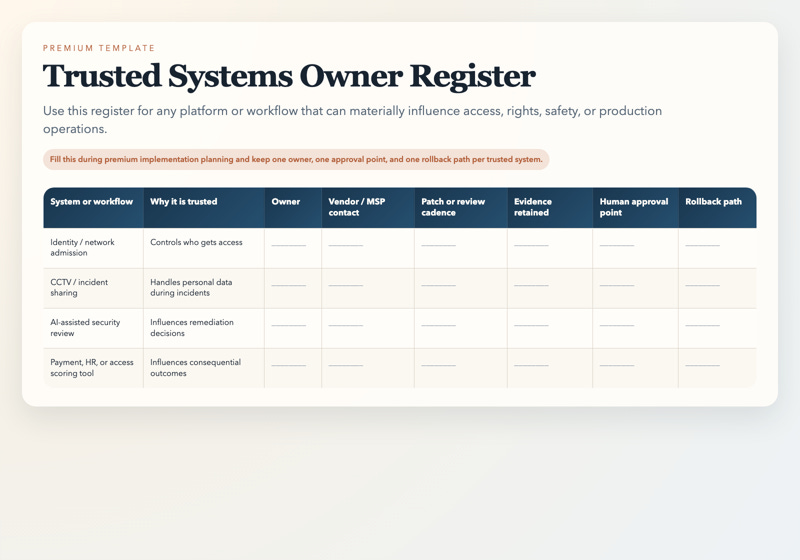
Premium Template: Trusted Systems Owner Register
Use this register for any platform or workflow that can materially influence access, rights, safety, or production operations.
Premium Checklist: Retail Crime Information-Sharing Controls
Document when staff may review CCTV and who approves access.
Define when footage or incident details may be shared outside the business.
Record the lawful basis and retention rule for each incident type.
Route complaints or objections to a named owner with a response timeline.
Keep facial-recognition proposals in a separate approval lane with higher scrutiny.
Confirm signage, notice language, and data-retention practice match real operations.
Premium Guide: Seven-Day Trusted Systems Hardening Sprint
Day 1: Inventory the trusted systems
List every platform that can change access, record incidents, approve sensitive activity, or influence production operations.
Day 2: Classify the owner
Write down the internal owner, the vendor or MSP contact, and the person who approves emergency changes.
Day 3: Verify patch or control status
For identity and network-control systems, compare running versions to vendor advisories and preserve admin or policy logs before changes.
Day 4: Review privacy and complaint handling
For surveillance or incident-response workflows, document what is captured, who may share it, how long it is retained, and where complaints land.
Day 5: Define AI approval boundaries
Split workflows into advisory-only, draft-and-review, and permissioned-execution lanes. Do not let one label cover all use cases.
Day 6: Run a short tabletop
Ask what happens if the trusted system is the system under pressure. Who decides? What evidence exists? What stops further action?
Day 7: Report the gaps
Deliver a one-page summary showing the systems reviewed, the open gaps, the named owners, and the next remediation date.
Premium Exercise: Tabletop for the Tool You Trust Most
Tabletop Exercise: The Gatekeeper Has the Emergency
Premise: A managed provider tells you that a Cisco ISE update must be applied urgently. On the same day, a store manager wants to circulate CCTV stills after a violent incident, and your operations lead wants an AI review tool to auto-close low-confidence findings to save time.
Exercise Goal: Test whether your team can identify the owner, evidence set, approval path, and stop condition for each trusted system before pressure leads to improvisation.
Use this exercise to: expose where authority is assumed, where records are missing, and where legal or security decisions are made by habit rather than by policy.
Premium Exercise: Trusted Systems Self-Assessment
Exercise Goal: Consider which tools in your business can grant access, identify a person, or recommend an operational action. Who owns each one? What evidence would you need to defend that process to a customer, regulator, insurer, or board member?
Sources
Cisco, "Cisco Identity Services Engine Remote Code Execution and Information Disclosure Vulnerabilities," first published June 17, 2026 and last updated July 6, 2026: https://www.cisco.com/c/en/us/support/docs/csa/cisco-sa-ise-multi-G5WP8vv.html
Information Commissioner's Office, "How data protection law can help protect businesses from crime," July 3, 2026: https://ico.org.uk/about-the-ico/media-centre/news-and-blogs/2026/07/how-data-protection-law-can-help-protect-businesses-from-crime/
Microsoft Security Blog, "Protecting Microsoft at AI speed: How SFI proactively hardens our cloud," July 8, 2026: https://www.microsoft.com/en-us/security/blog/2026/07/08/protecting-microsoft-at-ai-speed-how-sfi-proactively-hardens-our-cloud/