
This Week's SMB Risk Signals: Infostealers, HIPAA Fallout, and Computer-Using AI
What SMB leaders should verify now before credentials, regulators, or agents move faster than your controls.

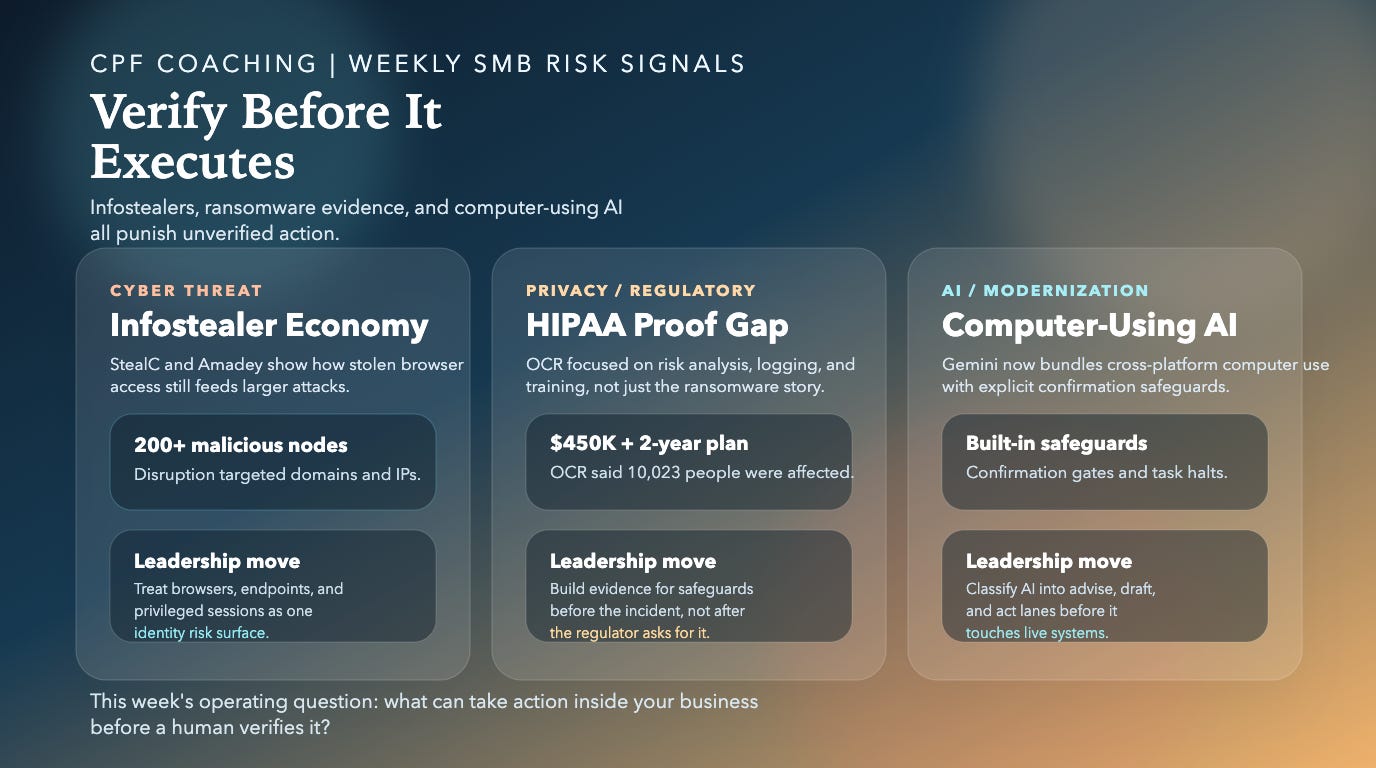
On June 24, 2026, Microsoft said its Digital Crimes Unit, working with Europol and industry partners, moved to disrupt more than 200 malicious StealC and Amadey command-and-control domains and IP addresses. Six days earlier, on June 18, 2026, HHS’ Office for Civil Rights announced a $450,000 HIPAA settlement after a ransomware incident at a health plan that potentially affected 10,023 people. Then on June 24, 2026, Google said computer use is now built directly into Gemini 3.5 Flash, giving teams a mainstream path to AI that can see, reason, and take action across browser, mobile, and desktop environments.
These are not separate stories. They are one operating lesson told from three angles. The software you trust can steal. The workflows you postpone can become regulatory evidence. And the AI you pilot for convenience can cross the line from draft help to real execution faster than your approval model catches up. If you lead an SMB with limited staff and a long to-do list, the real question this week is simple:
What inside your business can act before a human verifies it?
1. Infostealers Are Still Feeding Bigger Attacks
Microsoft said StealC is an infostealer that collects sensitive data from browsers, cryptocurrency wallets, messaging applications, email clients, and gaming platforms, while Amadey acts as a loader that can deliver StealC and other malware. Microsoft also said the disruption action on June 24 targeted more than 200 malicious domains and IPs tied to that infrastructure. The leadership takeaway is not only that one family got hit. It is that the credential-theft economy remains fast, modular, and commercially packaged.
Why You Should Be Concerned:
Credential theft is still the bridge to bigger damage: Microsoft explicitly tied infostealers to access brokers and downstream ransomware or follow-on operations.
The first infection can start outside your most managed systems: Microsoft warned defenders may only notice the breach after valid credentials are already being abused.
Browsers and user tools remain a soft spot: When browsers, email clients, and chat apps become collection points, one compromised endpoint can turn into a wider identity problem.
Strategic Action: Treat browser-stored access, local endpoints, and admin sessions as one control surface. If you are still separating endpoint protection from identity protection and browser hygiene, you are leaving too much room between infection and detection.
Three steps to take this week:
Revoke or rotate privileged sessions, admin cookies, and high-value credentials stored or recently used on unmanaged or lightly managed endpoints.
Confirm that every leader, finance user, and administrator is using managed endpoint protection and a password or passkey workflow that limits credential sprawl in the browser.
Review which SaaS admin accounts still allow broad access from a single endpoint without step-up verification or conditional access.
If your browser, email, and admin sessions are all one infostealer away from becoming an attacker’s launchpad, Bitdefender is a strong fit for SMB teams that need tighter endpoint visibility, isolation, and response coverage without building a large internal security operation.
2. Regulators Still Expect You to Show Your Work After Ransomware
HHS OCR said the ransomware investigation started after a health plan reported a breach tied to unauthorized access in November 2021. According to OCR, 10,023 individuals were potentially affected, and the plan paid $450,000 while agreeing to a two-year corrective action plan. OCR said the plan potentially failed to conduct an accurate and thorough risk analysis before the incident and failed to implement reasonable and appropriate policies and procedures under the HIPAA Privacy, Security, and Breach Notification Rules.
Why You Should Be Concerned:
Ransomware response is also a documentation risk: OCR did not stop at the breach itself. It focused on what the organization could not prove it had already assessed and implemented.
The data set matters: OCR said names, addresses, phone numbers, email addresses, and Social Security numbers were potentially affected, which raises both operational and trust costs.
Regulators spelled out the control expectations: OCR specifically highlighted risk analysis, audit controls, system activity review, authentication, encryption, incident lessons learned, and workforce training.
Strategic Action: Stop assuming your controls are real because they are familiar. I recognize many SMB teams are stretched thin and rely on a handful of people to cover IT, privacy, and security at once. That is exactly why you need an evidence trail that survives a bad week.
Three steps to take this week:
Map where regulated or otherwise high-sensitivity data enters, moves through, and leaves your systems, even if you are not a full-scale healthcare organization.
Document one current risk analysis for your most sensitive workflow instead of waiting for the perfect enterprise-wide assessment.
Verify that audit logging, authentication controls, encryption decisions, and workforce training are not just assumed but named, owned, and reviewable.
AFTER RANSOMWARE, “WE THOUGHT WE HAD IT COVERED” IS NOT A CONTROL.
OCR’s June 18 settlement shows that enforcement attention lands on the evidence behind your safeguards, not just your incident narrative. If risk analysis, policy maintenance, and control ownership still live across scattered documents and tribal knowledge, the cleanup cost goes up fast.
Copla is well matched for teams that need compliance automation, evidence collection, and expert support across frameworks without rebuilding the whole program from scratch.
Turn policy into proof. Review Copla here
3. Computer-Using AI Is Becoming a Real Operations Design Choice
Google said on June 24, 2026, that computer use is now a built-in tool in Gemini 3.5 Flash. Google said this lets developers build agents that can interact across browser, mobile, and desktop environments, and specifically framed the capability as a better fit for long-horizon automation tasks such as continuous software testing and knowledge work across professional applications. Google also said the release includes safeguards that can require explicit user confirmation for sensitive or irreversible actions and can automatically stop a task when indirect prompt injection is detected.
Why You Should Be Concerned:
This shifts AI from generation to action: Google is packaging computer use inside a mainstream model, not as a niche experiment.
The risk language is already in the launch copy: Prompt injection, sensitive actions, and the need for human-in-the-loop verification were central to Google’s own safety framing.
Your approval model now matters more than your model demo: When AI can click, navigate, and act across tools, the governance question becomes operational rather than hypothetical.
Strategic Action: Define where AI may advise, where it may draft, and where it may act only with approval. If a team cannot explain the trigger, owner, data boundary, and rollback for an agentic workflow, the workflow is not ready for production.
Three steps to take this week:
Pick one low-risk workflow where AI can act in a bounded environment and document the exact success condition, stop condition, and human approver.
Require confirmation for spending, external communication, security changes, and record updates rather than leaving those actions to default agent behavior.
Log every pilot with the tool used, systems touched, data involved, owner, and rollback path before expanding access.
Final Thoughts for Leaders
The common thread this week is execution without verification. Infostealers exploit it, regulators punish its absence, and AI that uses computers makes it easy to scale. Your job is no longer just to choose better tools. It is to decide which actions require proof, which systems can act alone, and which identities or agents need tighter boundaries before they can move. Put endpoint credential hygiene, risk-analysis evidence, and AI approval rules on your next leadership agenda before this week ends.
Subscribe to Unlock the Full Strategy
Join a community of SMB leaders who stop reacting to tech shifts and start leading them.
Help Other Leaders Secure Their Future
The Network Effect of SMB Security
The most effective way to strengthen our SMB community is to share strategies that actually work in the field. If you find value in these technical deep dives, helping a fellow leader bridge their tech gap makes the entire ecosystem more resilient. Cybersecurity is a collective effort and more informed peers lead to a safer environment for everyone’s business.
Why Share This Subscription? When you refer a colleague to this newsletter, you are giving them access to the same specialized insights you use to lead your team:
Zero-fluff technical execution: No high-level theory, just the steps to implement.
Cost-saving vendor analysis: Honest looks at which tools are worth the cost for SMB budgets.
Direct coaching frameworks: Access to the same logic I use with private coaching clients.
Pay It Forward Use the button below to share this post or your unique referral link. When your peers join our community, we all benefit from a more secure and tech-forward marketplace.
You’ve seen the "Why" behind this [Cyber/Tech Issue], but knowing the risk is only half the battle. To move from awareness to actual protection, you need a localized execution plan.
The remainder of this deep dive is designed specifically for the SMB leader who needs to move fast without a massive enterprise budget. By upgrading to a paid subscription, you unlock:
Premium Intelligence: The SMB Verification-and-Execution Pack
Premium readers get the implementation layer this week: the controls, decision structure, and working assets that translate the three stories above into operating discipline.
1. 72-Hour Infostealer Containment Plan for Lean SMB Teams
Technical Detail: Microsoft said StealC collects data from browsers, wallets, messaging applications, email clients, and gaming platforms, while Amadey helps deliver StealC and other malware. Microsoft also said defenders may only detect a problem after valid credentials are already being abused and that the disruption action covered more than 200 malicious domains and IPs.
Actionable Strategy:
Inventory the endpoints that hold administrator browser sessions, finance access, and shared SaaS credentials.
Force session revocation and password or passkey resets for high-value accounts after any credible infostealer indicator, even before full root cause analysis is complete.
Separate daily-use accounts from privileged accounts so an infected user session does not automatically become a business-wide identity event.
Leadership Focus Areas:
Credential concentration: Which devices and browsers hold the keys to payroll, banking, cloud admin, customer support, and identity providers?
Response speed: Who can disable sessions and revoke tokens after hours without waiting for an approval chain?
Detection depth: Which protections see suspicious browser, mail-client, or credential-store access before the attacker moves downstream?
2. OCR-Proof Ransomware Readiness for Data-Heavy SMB Workflows
Technical Detail: OCR said the health plan potentially failed to conduct a thorough risk analysis and failed to implement reasonable and appropriate policies and procedures before the ransomware incident. OCR also emphasized audit controls, information-system activity review, authentication, encryption, lessons learned, and workforce training as practical mitigation steps.
Actionable Strategy:
Build one defensible risk-analysis package around your highest-sensitivity workflow instead of trying to perfect every process at once.
Tie each stated safeguard to an owner, a review date, and the evidence location so you can prove its execution later.
Run a quarterly ransomware-readiness review that includes both technical recovery controls and documentation quality.
Control Focus Areas:
Evidence chain: Can you show the last review date, the owner, the control objective, and the supporting artifact for each safeguard?
Training relevance: Does workforce training reflect the actual workflows where sensitive data, admin access, or urgent overrides occur?
Auditability: If regulators or customers ask what changed after an incident, can you show the before-and-after and the approval record?
3. Computer-Use Agents Need an Approval Map Before They Need a Bigger Budget
Technical Detail: Google said that computer use is now built into Gemini 3.5 Flash for cross-platform tasks and explicitly described enterprise safeguards that may require user confirmation for sensitive or irreversible actions and can stop tasks when indirect prompt injection is detected. Google also positioned the capability for long-horizon tasks such as continuous software testing and knowledge work across professional applications.
Actionable Strategy:
Classify AI workflows into advisory-only, draft-and-review, and permissioned-execution lanes.
Require a short design record before any live rollout: objective, systems touched, data boundary, approval step, stop condition, and rollback path.
Keep early pilots inside sandboxed or test environments whenever the workflow can alter systems, records, or customer-facing outputs.
Governance Focus Areas:
Action authority: Which tasks can an agent complete versus prepare for human approval?
Prompt-injection exposure: Which workflows touch live web content, inboxes, or vendor systems that could manipulate the agent?
Economic guardrails: Who owns usage caps, exception approvals, and the cost of long-running automation?
AN AGENT THAT CAN CLICK IS PART OF YOUR OPERATING MODEL, NOT JUST YOUR TOOLSTACK.
If your organization is moving from chat prompts to computer-using workflows, the hard part is not generating output. It is controlling who can approve actions, what data the agent can touch, and how you recover when a task goes wrong.
Airia is built for teams that need stronger AI orchestration, policy controls, and governance as agentic workflows move deeper into real business operations.
Put guardrails around AI execution. Explore Airia here
Premium Template: Execution Authorization Matrix
Use this template for any workflow where software, a human identity, or an AI agent can trigger an action that changes access, money movement, customer communication, or regulated records.
Workflow name: Business owner: Technical owner: System or agent used: Trigger event: What can happen automatically: What requires confirmation: Sensitive data touched: Approval role required: Audit artifact retained: Rollback path: Budget or spend ceiling: Prompt-injection or spoofing exposure: Next review date:
Premium Checklist: 10-Day Verification Sprint
Identify the endpoints, browsers, and accounts that hold your most valuable sessions and tokens.
Reconfirm which privileged accounts still share devices or browsers for everyday browsing.
Document one current risk analysis for a high-sensitivity workflow and store the evidence where others can find it.
Verify audit logging, authentication, encryption, and training ownership for the same workflow.
Classify your current AI pilots into advise, draft, or act lanes.
Add approval gates for spending, external messaging, security changes, and record updates.
Name one person who can revoke sessions, disable an agent, or freeze a risky workflow after hours.
Test whether your rollback path is real for one automated or semi-automated workflow.
Review whether prompt injection or spoofing could reach any agent through inboxes, browsers, or web research tasks.
Schedule a follow-up review in 30 days to measure whether the controls changed behavior, not just documentation.
Premium Exercise: Friday 3:55 PM Verification Tabletop
Scenario: A finance manager reports strange browser prompts and reauthentication requests after visiting a vendor site. At the same time, a business unit asks to fast-track a new AI workflow that can log into internal tools and update project records automatically. Two hours later, legal asks whether the company can prove the current controls around sensitive data review after a recent ransomware scare.
Exercise objectives:
Decide which sessions, accounts, and devices are frozen within the first 30 minutes, and who has the authority to do so.
Decide what evidence the organization can produce today about risk analysis, logging, authentication, and training for the affected workflow.
Decide which AI workflows can continue, which must pause, and what approval conditions must be met before it can act again.
Questions to work through:
Which account, device, or browser state would cause the largest business impact if it were silently abused for 24 hours?
If a regulator or major customer asked for proof of safeguards tomorrow morning, what artifacts would you actually hand over?
If the AI workflow made the wrong update in a live system, who would detect it, stop it, and reverse it?
Sources
Microsoft Security Blog, “StealC and Amadey: Breaking down infostealers and the cybercrime services that deliver them,” published June 24, 2026: https://www.microsoft.com/en-us/security/blog/2026/06/24/stealc-and-amadey-breaking-down-infostealers-and-the-cybercrime-services-that-deliver-them/
HHS Office for Civil Rights, “HHS’ Office for Civil Rights Settles Ransomware Investigation with Health Plan,” published June 18, 2026: https://www.hhs.gov/press-room/ocr-settles-ransomware-investigation-health-plan.html
Google Blog, “Introducing computer use in Gemini 3.5 Flash,” published June 24, 2026: https://blog.google/innovation-and-ai/models-and-research/gemini-models/introducing-computer-use-gemini-3-5-flash/
The “How-To” Framework: A step-by-step breakdown of the [Process/Tool] mentioned above.
Resource Toolkit: Downloadable templates and checklists I use with my private coaching clients.
The Bottom Line: Direct analysis of the ROI and cost-savings associated with this strategy