

This Week's SMB Risk Signals: Patch the VPN Edge, Audit Broker Data, and Tier AI Work
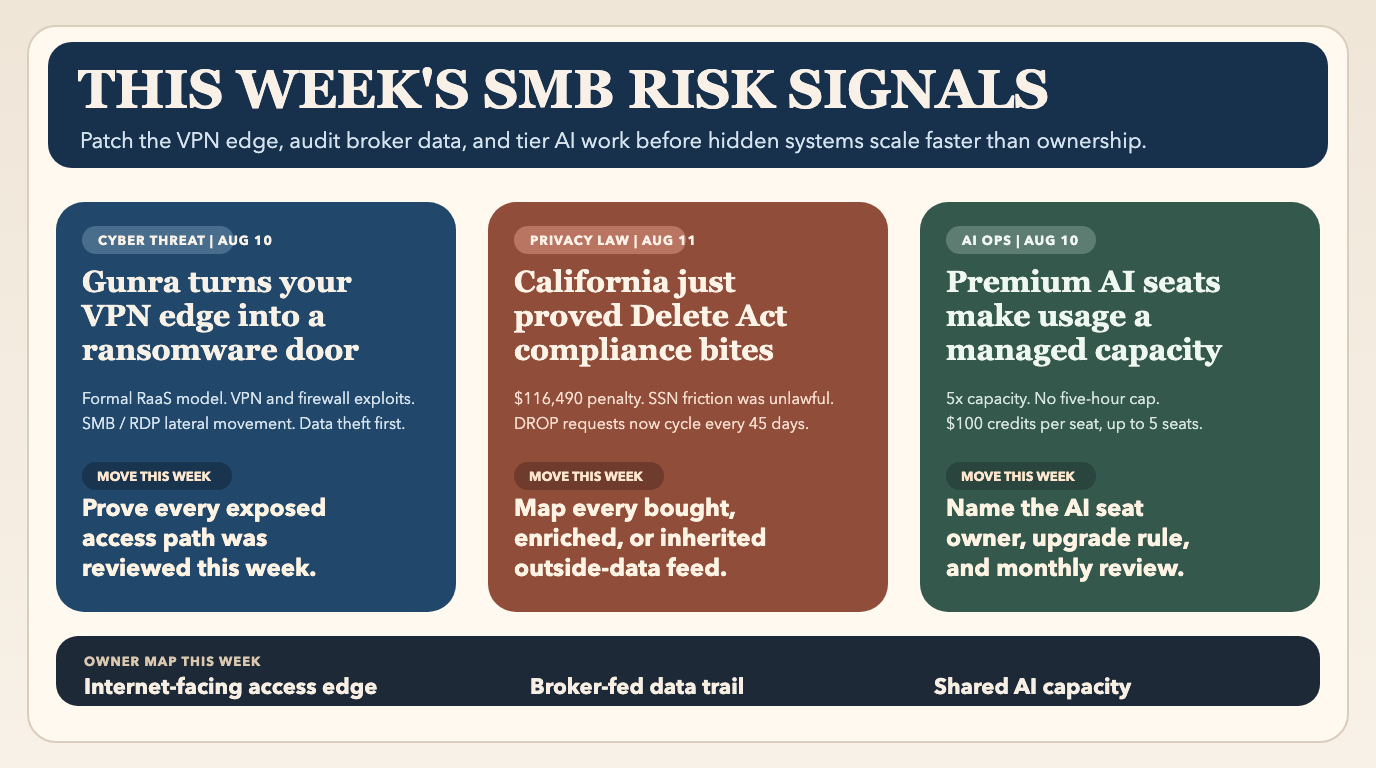
Gunra ransomware, California's first Delete Act case, and premium AI seats all point to one leadership move: assign owners to the hidden systems scaling behind daily work.

On August 10, 2026, U.S. and allied agencies published a joint #StopRansomware advisory on Gunra, a ransomware-as-a-service operation that is exploiting internet-facing VPN and firewall weaknesses, stealing data, and then encrypting systems. On August 11, 2026, California privacy regulators announced their first enforcement action under both the CCPA and the Delete Act after a data broker was fined and ordered to change how it handled Californians’ opt-out rights. One day earlier, OpenAI announced Premium seats for ChatGPT Business, which effectively turns heavy AI usage into a more explicit capacity, budget, and governance decision for smaller teams.
These stories sit in different lanes, but they point to the same management problem. The highest-risk systems in many SMBs now live just outside the main workflow: remote access edges, broker-fed data flows, and shared AI workspaces. If those systems scale faster than ownership, your team can lose control long before anyone feels like they made a “big” strategic decision
.1. Gunra Shows Why Your VPN Edge Is Still a Ransomware Door
Gunra matters because it is not just another named ransomware family. The August 10 advisory says the group has operated as a formal ransomware-as-a-service program since January 2026, targets organizations across sectors, and prioritizes known weaknesses in internet-facing devices, especially VPN and firewall infrastructure. The same advisory says Gunra actors exfiltrate data before encryption, move laterally with SMB and RDP activity, and have pushed victims into ransom negotiations that start in the tens of millions of dollars.
Why You Should Be Concerned:
This starts where lean teams often defer maintenance: The advisory says agencies observed Gunra exploiting known vulnerabilities in internet-facing devices, including FortiOS and FortiProxy authentication-bypass flaws.
The attack path is operational, not abstract: Agencies documented use of
psexec.py,smbclient.py, session hijacking, modified authentication files, and data theft from OneDrive and SharePoint before encryption.The blast radius is designed to expand fast: The advisory says victims have spanned healthcare, finance, manufacturing, transportation, government, retail, and professional services, which is a reminder that SMB adjacency does not keep you out of scope.
Strategic Action: Treat the VPN edge, remote admin tooling, and every exposed authentication layer as a privileged execution surface, not a background utility. The first question for leadership is no longer “Are we patched eventually?” It is “Who proves every externally reachable access path was reviewed this week?”
This Week’s Leadership Move:
Get a named answer on every internet-facing VPN, firewall, remote desktop, and MSP-managed access path your business depends on.
Require proof of patch state and exception state for known exploited flaws, not just a generic claim that devices are “current.”
Ask how your team would detect SMB/RDP lateral movement and pre-encryption exfiltration if the edge was already compromised.
For SMBs that need tighter endpoint containment when a compromised edge gives an attacker room to move, Bitdefender is a practical fit for improving device-level detection, isolation, and response while you validate remote-access and post-compromise controls.
Affiliate sponsor
2. California Just Proved the Delete Act Has Teeth
California’s August 11 action against LocateSmarter matters because it shows data broker compliance is no longer a theoretical future obligation. The California Privacy Protection Agency said LocateSmarter must pay $116,490 and change its practices after failing to register on time as a data broker and requiring Californians to provide partial Social Security numbers before they could opt out. The agency also reiterated that, beginning August 1, 2026, data brokers must access the Delete Request and Opt-Out Platform, or DROP, at least once every 45 days and process deletion requests, subject to limited exceptions.
Why You Should Be Concerned:
Privacy friction is now an enforcement issue: Regulators said requiring the last four digits of a Social Security number before an opt-out could intimidate consumers and violate data minimization requirements.
One request can now ripple through the broker ecosystem: California’s DROP system gives residents one mechanism to direct every covered data broker to delete personal information.
Inherited data trails are a leadership problem: If your CRM, outbound engine, or enrichment stack still depends on bought or broker-fed data, you now need a credible way to trace source, suppression, and deletion proof.
I recognize that many SMB teams did not deliberately design a broker-heavy data estate. They inherited it through old outbound experiments, agency relationships, enrichment tools, and sync jobs that kept running. That is exactly why this topic deserves executive attention now. Hidden data lineage is still data liability.
Strategic Action: Inventory where outside personal data enters the business, who can authorize its use, and how a deletion or opt-out request would propagate through your vendor chain. If nobody can produce that map quickly, the business is still relying on a blind spot.
This Week’s Leadership Move:
List every source in your CRM, outbound stack, and marketing tools that did not come directly from first-party customer action.
Flag which feeds came from a broker, enrichment vendor, list purchase, or reseller relationship.
Assign one owner for deletion proof and one owner for contract review, then make them compare the same source list this week.
IF YOU CANNOT TRACE THE DATA BROKER TRAIL, YOU CANNOT DEFEND IT
California’s first Delete Act enforcement action is a reminder that broker-fed data now carries operational obligations, not just marketing upside. The weak point for many SMBs is not the policy page. It is the quiet vendor chain behind the customer database.
Optery is a strong fit when you need to reduce personal-data exposure, remove records from broker ecosystems, and shrink the amount of discoverable information already circulating about executives and staff.
Reduce the exposed trail. See Optery
Affiliate sponsor
3. Premium AI Seats Turn Experimentation Into Budgeted Operations
OpenAI’s August 10 Premium seats announcement matters because it makes heavy AI usage look less like an informal perk and more like a managed operating lane. OpenAI says Premium seats for ChatGPT Business provide 5x more usage than Standard, remove the five-hour usage limit, and let workspace owners mix Standard and Premium seats inside one secure Business workspace. OpenAI also says Premium seats cost $125 per user per month, or $100 annually, and that eligible early customers can receive $100 in workspace credits per Premium seat for up to five seats.
Why You Should Be Concerned:
Higher-capacity AI is becoming a seat-allocation decision: Once you can mix lighter and heavier usage tiers inside one workspace, somebody has to decide who gets which capacity and why.
Shared usage is now a budget question: Premium pricing, credits, and higher limits shift AI from vague experimentation into a spend-managed team resource.
The administrative surface is broadening: Owners and admins can now reassign seats, monitor usage, and manage billing and spend in one place, which means your governance model needs to mature with the tool.
Strategic Action: Stop treating business AI as if cost, access, and workflow approval will sort themselves out later. Name an owner for seat allocation, usage review, and approved high-value workflows before the team normalizes expensive or sensitive patterns by habit.
This Week’s Leadership Move:
Decide which roles in your business truly need higher-capacity AI access and which do not.
Define what evidence a team member must show before moving from a standard seat to a premium seat.
Add one monthly review for AI seat allocation, high-value workflows, usage spikes, and exception approvals.
Final Thoughts for Leaders
This week’s signals all point to the same leaSharing is caring
If this week’s framing would help another operator or owner, use the native share and referral tools below before the premium section.dership lesson: the systems around your core workflow now deserve named owners before they deserve more scale. Your VPN edge can open the door to a ransomware operator. Your broker-fed data can trigger deletion and minimization duties you are not prepared to prove. Your AI workspace can become a shared budget and policy surface without anyone explicitly taking responsibility for it.
Put one item on your next executive agenda: list the background systems in your business that can grant access, import outside personal data, or consume shared AI capacity, and assign the owner for each one before next Thursday.
If another operator on your team needs this framing, use the share and referral tools below before the premium section.
If you want the implementation pack, ownerWhy not Subscribe
Paid subscribers get the implementation pack, owner register, checklist, and exercise for this week’s issue. register, checklist, and tabletop exercise below, the subscribe prompt is the fastest route into the premium section.
Paid subscribers this week get a backgrounPremium Intelligence: The Background Systems Control Pack
Welcome, premium subscribers. This week’s implementation pack is designed for leaders who need to govern the systems that sit behind the frontstage workflow but still carry real operational authority. The goal is to make those systems visible enough to assign ownership, budget, and interruption rules before they become emergency-response problems.
1. Gunra Deep Dive: Build an Edge-First Ransomware Response Assumption
Technical Detail: The August 10 joint advisory says Gunra first emerged in April 2025, expanded through a formal ransomware-as-a-service affiliate program in January 2026, and has been observed exploiting known vulnerabilities in internet-facing devices, including CVE-2024-55591 and CVE-2025-24472 in FortiOS and FortiProxy environments. Agencies also documented SMB-based lateral movement, session hijacking, modifications that bypassed MFA, credential dumping, and exfiltration from Microsoft OneDrive and SharePoint before encryption.
Prioritize the exposed path, not the average server: Patch and prove the state of every externally reachable VPN, firewall, remote desktop, and vendor-managed edge first.
Collect edge evidence weekly: Save screenshots, version exports, open exception tickets, and logs tied to who approved any delay.
Define a post-compromise branch: If the edge is already assumed hostile, document how you detect lateral movement, isolate endpoints, and decide when a vendor relationship becomes an incident-escalation issue.
2. Delete Act Deep Dive: Map the Broker Trail Before Requests Arrive
Technical Detail: California regulators said LocateSmarter both failed to register timely as a data broker and unlawfully required Californians to provide partial Social Security numbers before they could opt out. Separately, California’s DROP rules require data brokers to access the deletion mechanism at least once every 45 days and process consumer deletion requests, subject to limited exceptions.
Source map: Separate first-party data, partner-shared data, enrichment feeds, broker-sourced lists, and inherited legacy imports.
Routing rule: Define who receives a deletion request internally, which vendors must be contacted, and where confirmation evidence is stored.
Suppression control: Prevent deleted or opted-out records from being reintroduced by the same feed during the next sync cycle.
3. AI Seat Governance Deep Dive: Tier Usage Before Teams Normalize Spend
Technical Detail: OpenAI says Premium seats for ChatGPT Business provide 5x more usage than Standard, remove the five-hour limit, support mixed seat tiers in the same workspace, and allow workspace owners to manage billing, usage, and spend in one place. OpenAI also says the limited-time promotion offers $100 in workspace credits per Premium seat, up to five seats, for eligible early customers who join the waitlist by August 20, 2026.
Seat criteria: Document which roles qualify for heavier AI capacity and what business case must be shown.
Promotion discipline: Do not let a short-term credit offer create long-term seat sprawl without ownership.
Monthly review packet: Track who upgraded, why they upgraded, what workflows justified it, and whether the usage produced measurable value.
AI CAPACITY NEEDS AN OWNER BEFORE IT NEEDS AN EXPANSION
Once higher-capacity AI is available inside one shared workspace, the management challenge becomes seat policy, workflow approval, and data handling discipline rather than simple tool access.
Airia is a practical fit when you need policy-aware AI orchestration, clearer approval lanes, and stronger governance over which workflows can touch sensitive data or shared spend.
Govern the workload before it scales. Explore Airia
Affiliate sponsor
Premium Template: Background Systems Owner Register
Use this register for any platform, vendor, or workflow that can grant access, ingest outside personal data, or consume shared AI capacity on the company’s behalf.
Background system: The exact platform, vendor lane, or workflow.
Authority carried: What the system can do if left unchecked.
Named owner: The person responsible for policy, review, and exceptions.
Sensitive inputs: Credentials, regulated data, third-party records, contract text, pricing, payroll, or customer exports.
Proof artifact: The report, screenshot, ticket, or acknowledgment that proves control worked.
Stop condition: The event that forces a human checkpoint before the workflow continues.
Review cadence: Weekly, monthly, or event-driven validation frequency.
Premium Checklist: Seven-Day Background Systems Review
☐ Confirm the patch and exception state for every internet-facing VPN, firewall, RMM, and remote desktop path in scope.
☐ Save one proof artifact showing who reviewed the edge this week.
☐ Inventory every outside-data source feeding CRM, outbound, enrichment, or paid targeting systems.
☐ Assign the internal owner for deletion proof and the owner for vendor-contract review.
☐ Document which team owns AI seat allocation, usage review, and exception approvals.
☐ Define which AI workflows are allowed to touch contracts, customer exports, regulated data, or payroll-related material.
☐ Publish a one-page owner map covering edge access, broker data, and AI capacity.
Premium Guide: Five-Day Background Systems Reset
Day 1: Identify the systems with quiet authority
List every system that can open access, import third-party personal data, or consume shared AI capacity without another human checkpoint.
Day 2: Name the owner and the proof
For each system, assign the control owner and define the artifact that proves the control worked this week.
Day 3: Test the interruption path
Ask what happens when a critical edge advisory lands, a deletion request arrives, or a team asks for a premium AI seat. If the answer depends on informal memory, the process is not ready.
Day 4: Tighten the boundary
Pause unknown data feeds, close unowned access paths, and restrict high-risk AI workflows until the owner can explain the rule and the exception path.
Day 5: Publish the owner register
Put the system name, authority carried, owner, proof artifact, stop condition, and review cadence in one place leadership can actually use.
Premium Exercise: The Background System Already Acted
Tabletop Exercise: Hidden Authority, Public Consequences
*Premise:* A VPN appliance misses a critical patch window, a customer asks where broker-sourced information about them came from, and a department requests multiple premium AI seats after normalizing higher-usage workflows.
*Exercise Goal:* Test whether the team can name the owner, produce the proof artifact, explain the stop condition, and decide who is authorized to interrupt the workflow.
*Use this exercise to:* expose where quiet systems already carry more business authority than leadership has explicitly governed.
Sources
Joint
#StopRansomware: Gunra Ransomwareadvisory, August 10, 2026CalPrivacy: first action under both the CCPA and Delete Act, August 11, 2026
OpenAI: Premium seats are coming to ChatGPT Business, August 10, 2026d-systems owner register, a broker-trail cleanup checklist, an AI seat governance rubric, and a tabletop exercise built to expose who actually controls these quiet systems in your business.