
AI Weaponization and Regulatory Fragmentation: The New Normal for SMB Tech Leaders
An analysis of the top trending security and privacy topics of the last week and their direct impact on your business strategy.

We are only a few weeks into 2026, and the narrative for small and medium-sized business (SMB) leaders is already clear: the era of “flying under the radar” is officially over. The threats are more sophisticated, the regulations are more complex, and your vulnerabilities are likely sitting outside your direct control.
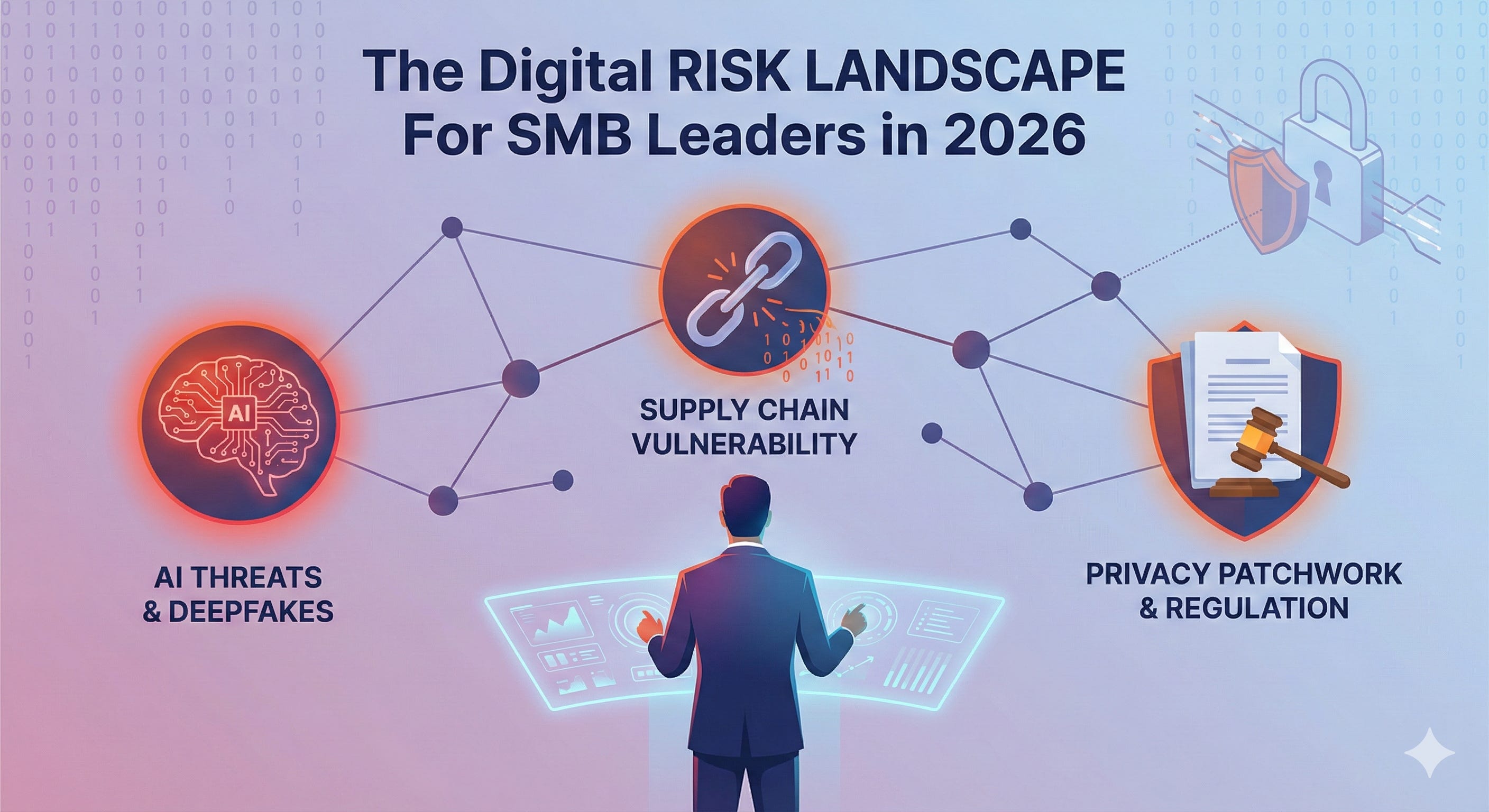
For tech, legal, and cybersecurity leaders in the SMB space, the last week has highlighted a convergence of risks that demands immediate strategic attention. It is no longer sufficient to rely solely on a firewall and antivirus software. You need a holistic risk strategy that accounts for AI, your entire supply chain, and a rapidly shifting legal landscape.
Here are the top three trending topics you need to be concerned about and, more importantly, what you should be doing about them.
1. The Weaponization of AI: Deepfakes and Hyper-Targeted Phishing
The honeymoon phase with generative AI is over. While businesses are figuring out how to use these tools for productivity, cybercriminals have already weaponized them with frightening efficiency. Deepfake-enabled attacks, in particular, have surged dramatically, with reported incidents up 400% since 2025. The most significant shift we’re seeing is the move from generic, mass-email attacks to highly personalized, AI-crafted campaigns.
Why You Should Be Concerned:
SMBs Are the Prime Target: Your employees face a 350% higher rate of social engineering attacks than their counterparts at large enterprises. Attackers know you have valuable data but fewer resources to defend it. I recognize that for many SMBs, stretched budgets and small IT teams make it feel like you are fighting an uphill battle against better-resourced threats. Navigating the security poverty line is a real, daily challenge, and it is precisely these constraints that attackers seek to exploit.
Deepfake CEO Fraud: This isn’t science fiction. We are seeing a surge in “CEO fraud” where attackers use AI to create convincing voice or video deepfakes of executives to authorize fraudulent wire transfers. These attacks have already cost businesses hundreds of millions of dollars in the first quarter of 2026 alone.
Phishing on Steroids: AI can now analyze public data to create phishing emails that are virtually indistinguishable from legitimate communications, bypassing traditional red flags like poor grammar or generic greetings.
Strategic Action: The human firewall is your most critical defense. Move beyond annual compliance training and implement continuous, simulation-based phishing training that evolves with these new AI tactics. Establish strict, multi-channel verification protocols for all financial transactions and sensitive data requests. If an urgent request arrives via email, verify it by calling a known number.
Three steps to take tomorrow morning:
Enable multi-factor approval for all payments and financial transactions.
Schedule a monthly phishing simulation for your team.
Audit and tighten controls for impersonation and identity verification, especially for requests involving sensitive information.
2. The Regulatory Patchwork: A New Compliance Headache
In the absence of a unified federal standard, individual states are taking the lead on AI and data privacy regulation. The result is a fragmented legal patchwork that is becoming expensive and complicated for SMBs operating across state lines. To keep up, SMBs need to embrace privacy by design, viewing compliance not as a box to check, but as an ongoing engineering and business process that shapes every new system and workflow.
Why You Should Be Concerned:
Rising Compliance Costs: Recent data indicate that SMEs are spending up to 17% of their AI investment just on regulatory compliance. This is a tax on innovation that larger competitors can absorb more easily.
High-Stakes Hiring: States such as Illinois, California, and New York have enacted laws regulating the use of AI in employment decisions to prevent bias. If your HR team uses automated tools to screen resumes or conduct video interviews, you could be facing significant legal exposure without proper auditing and transparency disclosures. Ask yourself: Have we audited our resume-screening or interview AI tools in the past six months to ensure compliance and fairness?
Consumer Rights & Transparency: New privacy laws are mandating clear disclosures about when and how you are using consumer data with AI systems, granting individuals rights to opt out of automated decision-making.
Strategic Action: Conduct an immediate legal and operational review of all AI tools currently in use, especially in HR and marketing. Instead of assuming your vendors are compliant, invite them to join you in a co-audit process to ensure you are both meeting regulatory requirements. Work with outside counsel to map your regulatory exposure based on where your customers and employees are located, and update your privacy policies and internal procedures accordingly.
3. The “Backdoor” Breach: Supply Chain Vulnerabilities
Your security is only as strong as your weakest vendor. Attackers are increasingly bypassing direct assaults on a company’s primary infrastructure in favor of infiltrating a trusted third-party supplier. For example, in a recent incident, hackers first compromised an SMB’s IT managed service provider, then used the provider’s remote access tools to quietly exfiltrate sensitive data from the SMB. Once inside a vendor’s system, they can ride legitimate connections straight into yours.
Why You Should Be Concerned:
It’s How Most Breaches Happen: Over 60% of data breaches now involve a third party. The recent high-profile attacks on major supply chains demonstrate that this vector can result in severe operational disruption and substantial financial losses. For context, the average cost to recover from a third-party breach is estimated at $2.4 million, with downtime frequently exceeding two weeks. These consequences strike regardless of your own internal security posture.
Implicit Trust is a Liability: You likely trust your payroll provider, your cloud storage host, and your managed IT service. Attackers are counting on that trust. A compromise at any one of these points gives them a “backdoor” into your critical systems.
Strategic Action: You must implement a formal Vendor Risk Management (VRM) program. This isn’t just about sending out a questionnaire once a year. You need to identify your critical vendors (those with access to sensitive data or critical systems), define security requirements for them, and actively monitor their compliance. Contractual clauses regarding security standards and breach notification are now non-negotiable.
To help you get started, here is a practical timeline to make VRM adoption actionable:
This week: Identify and list all your critical vendors, with a focus on those that have access to sensitive data or critical systems.
Next week: Draft and update contractual clauses to include minimum security requirements and mandatory breach notification.
Within the next two weeks: Set up a schedule for regular compliance reviews and request recent security documentation from your top vendors.
Ongoing: Monitor vendor compliance continuously and establish a process to review new vendors before onboarding.
Treat VRM as an ongoing project with clear milestones, not a one-time task. By following this timeline, you will turn abstract advice into concrete, manageable steps.
Final Thoughts for Leaders
The convergence of these risks means that cybersecurity is no longer an IT problem; it is a core business risk. As a leader, your role is to ensure your organization builds resilience, not just buys tools. The question is not if an incident will occur, but how prepared you are to detect it, respond to it, and recover from it. True resilience looks like faster threat identification, minimized downtime, and clear, transparent communication with customers, even in the middle of a crisis. When you are prepared, incidents are contained quickly, customer trust is preserved, and your business can return to normal operations with minimal disruption. This is the vision all leaders should aim for: resilience that turns inevitable challenges into manageable, recoverable events.
Add cybersecurity and resilience planning to your next executive team agenda, ideally by next Monday. Setting a clear time and place ensures this critical conversation does not get deferred. The cost of inaction is far too high.